





What's Happening?
The U.S. Department of Transportation (USDOT) has granted $28 million to the Lafayette Consolidated Government (LCG) for the development of an interchange at Kaliste Saloom Road and U.S. 90 in Lafayette, Louisiana. This funding is designated for final
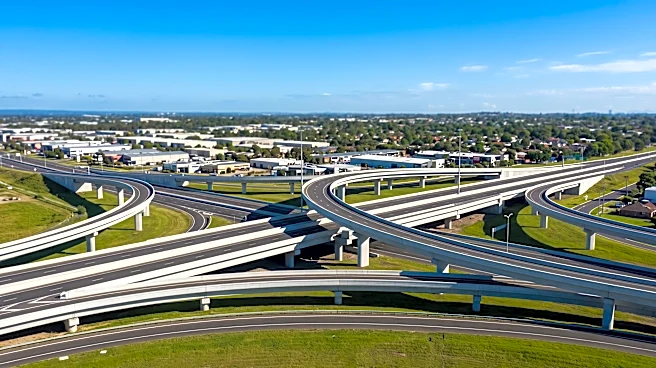
engineering and pre-construction activities. The project aims to transform the current signalized intersection into a grade-separated interchange, incorporating ramps, flyover bridges, and roadway enhancements across approximately 2.2 miles of Kaliste Saloom Road and 3.5 miles of U.S. 90. This initiative is part of a larger $426 million federal grant program, the Nationally Significant Multimodal Freight & Highway Projects (INFRA), distributed among 12 projects in 12 states. The Lafayette project is specifically targeted at alleviating one of the top 100 freight bottlenecks in the U.S. The total cost of the I-49 Connector is estimated to be between $2 billion and $2.5 billion, with this grant contributing to a critical segment. Louisiana Department of Transportation and Development (DOTD) is providing $31.5 million and LCG $500,000 as matching funds.
Why It's Important?
This federal grant is crucial for improving regional mobility and supporting economic development in Lafayette and the broader I-49 corridor. The existing intersection at Kaliste Saloom Road and U.S. 90 is identified as a significant freight bottleneck, causing congestion and delays. By converting it into a grade-separated interchange, the project is expected to reduce crash risks, enhance travel-time reliability, and facilitate smoother freight movement. U.S. 90 serves as a vital freight corridor connecting Interstate 10 with regional and national markets, ports, and industrial facilities. The improved infrastructure will likely benefit local businesses by streamlining logistics and reducing transportation costs, potentially attracting new investments to the region. For residents, the project promises reduced commute times and enhanced safety. The support from congressional offices, including Representatives Clay Higgins and Cleo Fields, and Senators Bill Cassidy and John Kennedy, underscores the project's perceived importance at both federal and state levels for Louisiana's infrastructure and economic future.
What's Next?
Following the grant award, the Lafayette Consolidated Government will proceed with the final engineering and other critical pre-construction work, which includes advancing final engineering plans, right-of-way acquisition, and utility relocation. Environmental review steps are still underway, with officials having signed the Draft Supplemental Environmental Impact Statement in July. Public hearings have been conducted, and comments are being reviewed by the DOTD and the Federal Highway Administration (FHWA). The final step in this phase is the publication of a Record of Decision, which is estimated to be completed by March 15, 2027. While the announcement did not specify a construction start date, additional information regarding the project timeline and next steps will be released as development progresses. The successful completion of these pre-construction phases is essential for securing the remaining approximately $2 billion in funding needed for the full I-49 Connector project.
Beyond the Headlines
The I-49 Connector project, which has been in development since the late 1980s, highlights the long-term challenges and complexities associated with major infrastructure initiatives in the U.S. The incremental funding approach, with federal grants supplementing state and local contributions, reflects a common strategy for financing large-scale projects that are too costly for any single entity to undertake. The emphasis on environmental review, including public hearings and impact statements, underscores the increasing importance of addressing ecological and community concerns in infrastructure development. This project also illustrates the critical role of political consensus and bipartisan support, as evidenced by the backing from multiple congressional representatives and senators, in securing federal funding for regional priorities. The successful execution of this interchange could serve as a model for other states grappling with outdated infrastructure and freight bottlenecks, demonstrating how targeted investments can yield significant economic and safety benefits.