






What's Happening?
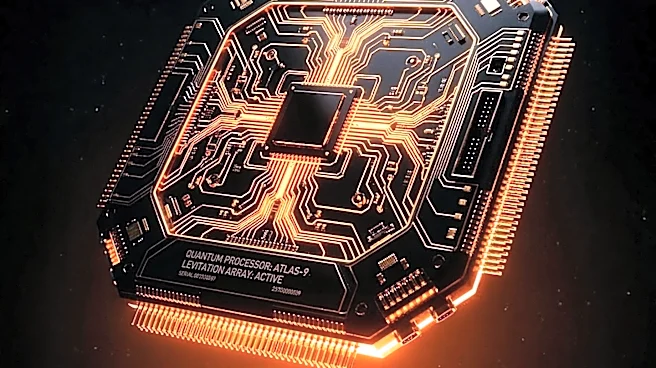
IBM Quantum has announced a significant engineering breakthrough in its pursuit of modular fault-tolerant quantum computing. The company successfully operated four meter-scale cryogenic quantum interconnects, known as L-couplers, between two full 120-qubit
IBM Quantum Nighthawk R1 superconducting processors. This development, detailed in an arXiv preprint and an IBM Research technical overview, demonstrated an average inter-chip quantum state transfer fidelity of 99.00%, with a peak of 99.29%. Furthermore, these L-couplers supported inter-processor distant CZ entangling gates with an average fidelity of 94.75%. This marks the first multi-channel, meter-scale interconnect architecture specifically designed for the mechanical and thermal demands of large, production-grade quantum processors housed within shared dilution refrigerators. The modular architecture is intended to form the physical foundation for IBM’s upcoming fault-tolerant processor, IBM Quantum Starling, which is slated for release in 2029.
Why It's Important?
This milestone is crucial for the advancement of quantum computing, particularly in the U.S., as it addresses a fundamental challenge in scaling quantum processors. Previous attempts to link few-qubit superconducting chips were largely confined to laboratory settings. IBM's success in creating robust, meter-scale interconnects that can withstand repeated thermal cycling and operate simultaneously without interference provides the necessary physical connectivity to transition from monolithic processors to distributed quantum supercomputers. This development is vital for building fault-tolerant quantum systems, which are essential for tackling complex problems in fields like drug discovery, materials research, and advanced simulations that are currently beyond the capabilities of even the most powerful supercomputers. The ability to connect multiple quantum processors reliably will accelerate the development of more powerful and practical quantum computers, potentially impacting various U.S. industries by enabling new computational capabilities.
What's Next?
IBM plans to integrate these L-coupler junctions directly into native lattice qubits and extend L-qubit lifetimes to further reduce state transfer errors, aiming for fidelities below 10^-3 and pushing distant CZ fidelities above 99%. This will be critical for the development of IBM Quantum Starling, their fault-tolerant processor planned for 2029. The validation of these high-coherence links suggests that modular architectures can tolerate inter-module link error rates that are higher than internal gates, while still significantly reducing the overall physical qubit overhead for error correction. This approach is expected to pave the way for the construction of distributed quantum supercomputers, moving quantum computing from experimental curiosity to operational reality. Future efforts will likely focus on refining the manufacturing processes and integrating these modular components into larger, more complex quantum systems.
Beyond the Headlines
The successful implementation of meter-scale quantum interconnects by IBM signifies a shift in quantum computing development from isolated laboratory experiments to industrial-scale engineering. This breakthrough has profound implications for the long-term viability and scalability of quantum technology. By demonstrating that quantum information can be reliably transferred over longer distances between distinct processors, IBM is laying the groundwork for a future where quantum computers are not single, monolithic units but rather interconnected networks of quantum processing units. This modular approach could democratize access to quantum computing resources, allowing for more flexible and powerful configurations. It also highlights the increasing importance of interdisciplinary collaboration, combining quantum physics with advanced engineering and materials science, to overcome the significant technical hurdles in this nascent field. The ethical and societal implications of such powerful computing capabilities, particularly in areas like cryptography and scientific discovery, will become increasingly relevant as these technologies mature.