



What's Happening?
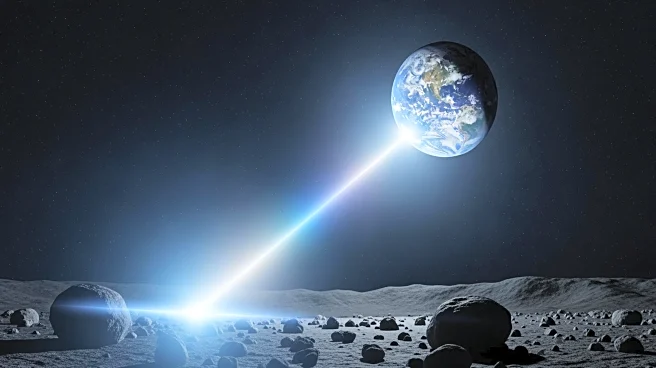
Recent research has revealed that Earth's atmosphere extends all the way to the moon, with atoms and molecules traveling across space along magnetic field lines. This discovery, made by a team at the University of Rochester, suggests that Earth's atmospheric
particles have been settling on the moon for billions of years. The findings provide a potential historical record of Earth's atmosphere on the lunar surface, which could be valuable for future lunar bases. The study also indicates that the moon may have a greater abundance of useful elements, such as water and nitrogen, than previously thought, which could support human habitation.
Why It's Important?
This discovery has significant implications for future lunar exploration and the establishment of lunar bases. The presence of Earth's atmospheric particles on the moon could provide resources necessary for sustaining human life, such as water and other volatiles. This could reduce the need to transport these resources from Earth, making lunar habitation more feasible and cost-effective. Additionally, the historical record of Earth's atmosphere preserved on the moon could offer insights into the planet's climatic and environmental history, aiding scientific research and understanding of planetary evolution.