
What's Happening?
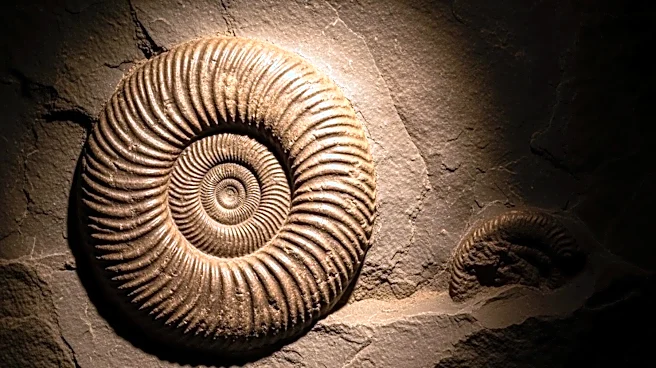
A fossil previously identified as the oldest known octopus has been reclassified as a different marine animal, challenging long-held assumptions about cephalopod evolution. The fossil, Pohlsepia mazonensis,
discovered at the Mazon Creek site in Illinois, was initially described in 2000 as a cirrate octopod, suggesting an earlier origin for octopuses by 150 million years. However, new research using synchrotron micro-X-ray fluorescence imaging revealed a radula, a feeding organ with teeth, indicating it is a nautiloid relative, not an octopus. This reclassification impacts molecular clock studies that used the fossil as a calibration point, now supporting a Jurassic period divergence for crown octopuses.
Why It's Important?
The reclassification of Pohlsepia mazonensis has significant implications for understanding cephalopod evolution. By correcting the fossil's identity, the timeline for octopus evolution is adjusted, aligning with existing evidence of their divergence during the Jurassic period. This change affects previous molecular clock analyses that inferred a Paleozoic origin for major coleoid lineages, including octopuses, squids, and cuttlefish. The findings highlight the importance of advanced imaging techniques in paleontology, which can resolve ambiguities in fossil interpretation and provide more accurate evolutionary timelines.