






What's Happening?
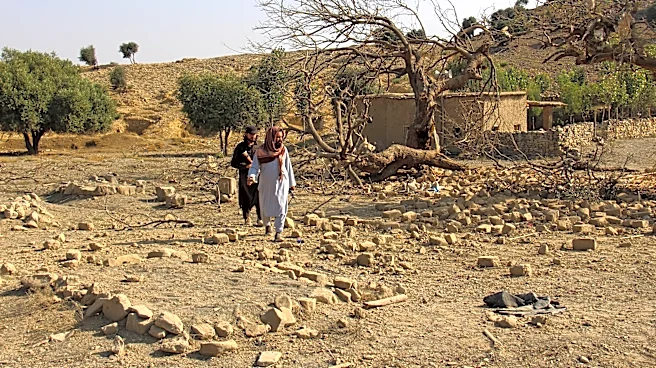
Pakistan has reported its fifth polio case of the year, involving a 17-month-old girl in the Bannu division of Khyber Pakhtunkhwa (KP). This brings the total number of cases in the country to five, with four detected in Bannu and one in Sindh. Despite
a significant 99.8% reduction in polio cases since the early 1990s, transmission of the virus remains persistent in southern KP. Officials attribute the overall drop in cases to improved vaccination campaign performance and the onset of winter, which is considered a low-transmission season. However, security challenges in areas like Bannu continue to pose a threat to eradication efforts, with instances of campaigns being halted and polio team workers being kidnapped.
Why It's Important?
The emergence of new polio cases, particularly in a concentrated area like Bannu, underscores the fragility of polio eradication efforts in Pakistan. While the country has made substantial progress in reducing cases, the continued presence of the virus highlights the critical need for sustained and robust vaccination campaigns. The security challenges in southern KP are a significant impediment, creating environments where the virus can persist and potentially rebound. This situation not only endangers the health of children within Pakistan but also poses a risk of international spread, as polio eradication is a global health priority. The persistence of the virus in specific regions necessitates a targeted and adaptable approach to overcome both logistical and security hurdles.
What's Next?
In response to the new case, there is an urgent call to maintain strong surveillance and vaccination efforts nationwide. The Pakistan Polio Programme emphasizes that no child is safe until every child is vaccinated. The ongoing Pakistan-Afghanistan tensions are also noted as a potential factor that could allow the virus to rebound, suggesting a need for regional cooperation. Efforts will likely focus on addressing the security-related issues in Bannu to ensure uninterrupted vaccination campaigns. The program will continue to monitor environmental samples for poliovirus and adapt its strategies to reach all eligible children, especially as the country enters a low-transmission season, to prevent further spread.
Beyond the Headlines
The recurring polio cases in Pakistan, particularly in conflict-affected regions, highlight the complex interplay between public health, security, and geopolitical stability. The challenges faced by polio eradication teams, including security threats and community resistance, reflect broader issues of governance and trust in vulnerable populations. The persistence of polio in these areas can also be seen as a symptom of broader systemic weaknesses that hinder the delivery of essential services. Addressing these deeper issues, beyond just vaccine distribution, is crucial for achieving lasting health outcomes. The situation underscores the ethical imperative of protecting healthcare workers and ensuring access to life-saving interventions in all communities, regardless of their geopolitical context.