





What's Happening?
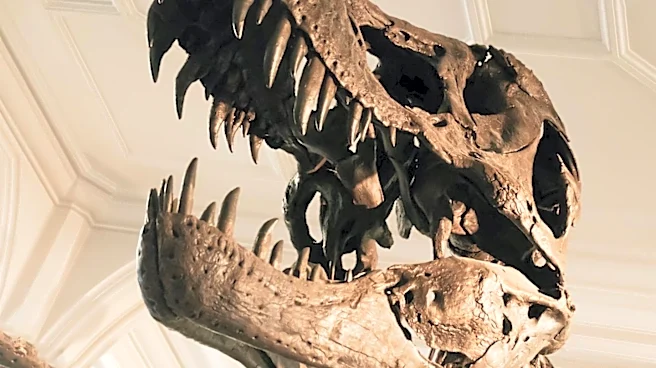
A new study published in Frontiers in Ecology and Evolution suggests that dinosaurs and their prey in North America, particularly those in coastal regions during the Cretaceous period, supplemented their diets with marine resources like seaweed. Researchers
analyzed carbon isotopes (C-12 and C-13) in fossilized teeth from various dinosaurs, crocodiles, turtles, and fish found in sites that were once coastal along the Western Interior Seaway and the ancient Gulf of Mexico coastline. The ratio of these isotopes, expressed as δ13C, acts as a chemical 'fingerprint' of an animal's diet. The analysis revealed higher δ13C values in fossils from coastal sites compared to landlocked formations, indicating the consumption of marine organic matter. This pattern was consistent across coastal sites, regardless of latitude or age, marking the first identification of marine subsidization in prehistoric ecosystems. The study posits that marine macroalgae or macrophytes, commonly known as seaweeds, were the most likely source of this marine organic matter.
Why It's Important?
This research significantly alters our understanding of ancient food webs and the dietary habits of dinosaurs, particularly in North America. Previously, it was largely assumed that most terrestrial dinosaurs relied solely on land-based plants. The discovery of marine subsidization suggests a more complex and adaptable feeding strategy, highlighting the interconnectedness of terrestrial and marine ecosystems millions of years ago. This finding could lead to a re-evaluation of dinosaur paleoecology and the environmental conditions of the Cretaceous period. Understanding how ancient ecosystems adapted to available food sources, especially during periods of environmental stress, can offer insights into ecological resilience. The study also emphasizes the long-standing importance of environmental linkages across time and space, underscoring the need to protect these connections in modern ecosystems.
What's Next?
Future research will aim to determine if marine subsidization was a widespread phenomenon across different latitudes and during other geological periods, such as the preceding Jurassic Period or the subsequent early Cenozoic Era. The current dataset, while demonstrating marine subsidization in coastal deposits, lacks data from polar and equatorial latitudes during the early Albian and early Cenomanian. Further investigations will also explore the specific types of marine organisms consumed and the extent to which different dinosaur species incorporated marine resources into their diets. This could involve analyzing more fossil samples from diverse geographical locations and timeframes, potentially revealing more nuanced dietary preferences and ecological interactions within ancient North American ecosystems.
Beyond the Headlines
The study's findings challenge conventional views of dinosaur diets and highlight the adaptability of ancient life forms. The concept of marine subsidization, where terrestrial animals rely on marine resources, is observed in modern ecosystems, particularly in coastal areas. This research suggests that such ecological interactions have a deep evolutionary history, extending back to the age of dinosaurs. It underscores the idea that ecosystems are rarely isolated and that nutrient and energy flows often transcend perceived boundaries between terrestrial and aquatic environments. This deeper understanding of ancient ecological resilience and interconnectedness can inform contemporary conservation efforts, emphasizing the importance of preserving the intricate linkages within and between ecosystems to maintain biodiversity and ecological stability.