





What's Happening?
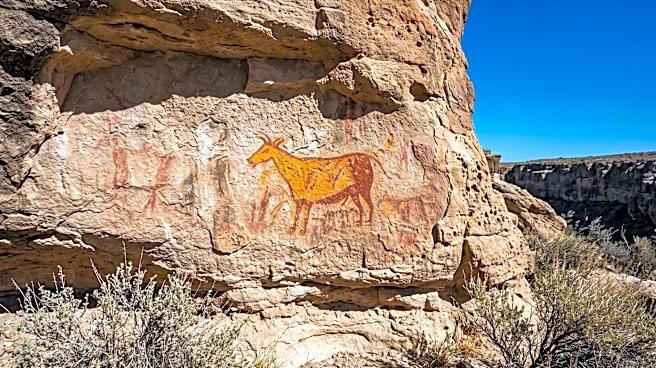
A NASA-developed image processing technique, initially designed to enhance satellite photos of Mars, has been successfully applied to uncover faded ancient artwork on Earth. Jon Harman, a rock art enthusiast with a background in medical imaging and mathematics,
adapted NASA's 'decorrelation stretch' algorithm. This technique, which enhances color variations and distributes pixels across a wider color range while preserving hue, saturation, and intensity, was first encountered by Harman at a 2005 rock art conference. He developed a plug-in, later an app called Dstretch, based on a NASA paper explaining the algorithm. Harman first tested Dstretch on photos of rock art in Baja California, Mexico, where it revealed a previously unseen yellow figure. The effectiveness of Dstretch has led to its widespread adoption by archaeologists globally, aiding in the discovery of undocumented figures and artwork in various locations, including Egypt, Canada, and Greece. It has even been used to enhance images of tattoos on mummified remains.
Why It's Important?
This development highlights the unexpected and far-reaching applications of scientific research and technology across different fields. A technique created for planetary exploration is now a crucial tool for archaeological discovery and preservation on Earth. The ability of Dstretch to reveal faded and otherwise invisible ancient artwork provides invaluable insights into human history, culture, and artistic expression that would otherwise remain lost. This cross-disciplinary utility underscores the potential for technological advancements in one sector to revolutionize others, demonstrating the interconnectedness of scientific and historical research. It also empowers archaeologists with a non-invasive method to study delicate and deteriorated artifacts, ensuring their preservation while maximizing the information extracted from them. The success of Dstretch showcases how open-source scientific knowledge and accessible technology can lead to significant breakthroughs in understanding our past.
What's Next?
The continued application of Dstretch by archaeologists worldwide is expected to lead to further discoveries of ancient art and historical artifacts. As more researchers become aware of and utilize this tool, the potential for uncovering previously unknown cultural heritage sites and artworks will increase. The success of Dstretch may also inspire the adaptation of other advanced imaging and data processing techniques from fields like space exploration or medical imaging for archaeological and historical research. This could lead to the development of new tools and methodologies for studying and preserving ancient human records. Furthermore, the accessibility of Dstretch as an app suggests that it could become a standard tool in archaeological fieldwork and research, potentially integrating into broader digital archaeology practices.
Beyond the Headlines
The story of Dstretch transcends a simple technological application; it embodies the spirit of interdisciplinary innovation and the democratization of scientific tools. It illustrates how a passion for history, combined with a deep understanding of scientific principles, can bridge seemingly disparate fields like space exploration and archaeology. This cross-pollination of ideas not only enriches our understanding of ancient civilizations but also demonstrates the universal applicability of scientific methodologies. The ability to 'see' what was previously invisible challenges our perceptions of historical records and opens new avenues for interpreting human development and artistic evolution. It also raises ethical considerations regarding the interpretation and preservation of newly discovered artifacts, emphasizing the responsibility that comes with such powerful tools.