
What's Happening?
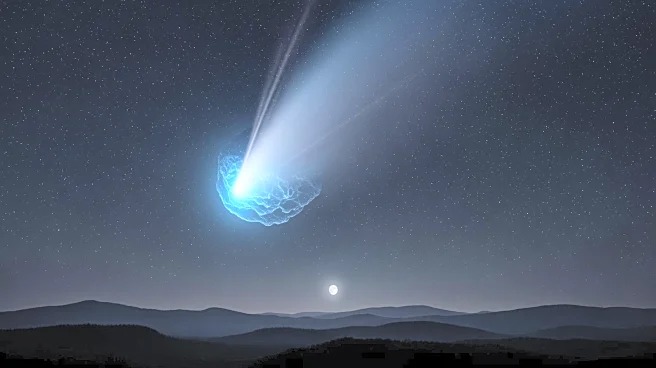
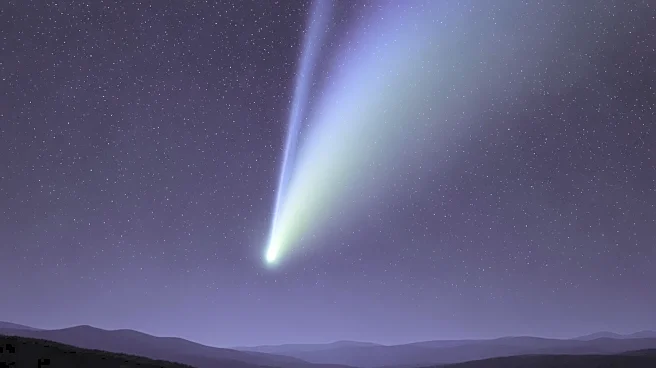
A newly discovered comet, C/2025 R3 (PanSTARRS), is anticipated to provide a unique visual spectacle in the sky in 2026. Discovered on September 8, 2025, using the Panoramic Survey Telescope and Rapid
Response System, this comet is believed to originate from the Oort cloud. Currently, it is approximately 348 million kilometers from Earth. Astronomers classify it as a long-period comet, taking over 1,000 years to orbit the Sun. The comet will be closest to the Sun on April 20, 2026, at a distance of about 76.3 million kilometers, and will pass approximately 70.8 million kilometers from Earth on April 27, 2026. However, its visibility might be affected by the Sun, making April 17, 2026, a crucial date for sky watchers to potentially observe it.
Why It's Important?
The appearance of comet C/2025 R3 (PanSTARRS) presents a rare opportunity for astronomers and the general public to witness a celestial event that occurs once in a millennium. Such events can significantly boost interest in astronomy and space sciences, potentially inspiring educational initiatives and public engagement in scientific exploration. For the scientific community, observing the comet could provide valuable data on the composition and behavior of long-period comets, contributing to our understanding of the solar system's formation and evolution. The event also holds cultural significance, as comets have historically been seen as omens or symbols in various cultures, potentially sparking renewed interest in cultural astronomy.
What's Next?
As the comet approaches, astronomers will likely conduct further observations to refine predictions about its path and visibility. Public and private observatories may organize viewing events, and educational institutions might develop programs to engage students and the public. The scientific community will prepare to collect data on the comet's composition and trajectory, which could lead to new insights into the nature of long-period comets. Additionally, media coverage is expected to increase as the date of the comet's closest approach nears, raising public awareness and interest.