





What's Happening?
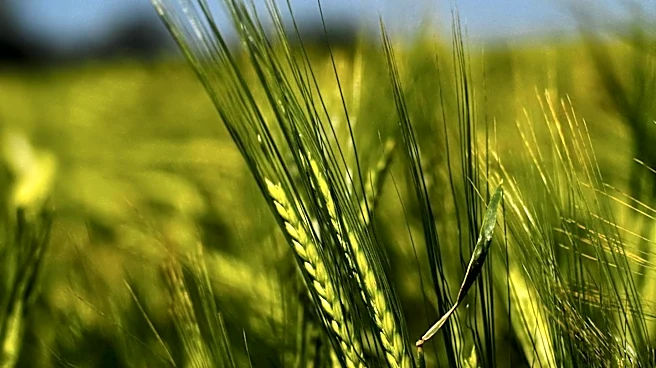
A field day in East Troy, Wisconsin, organized in partnership with the Michael Fields Agricultural Institute, aims to educate farmers on the benefits and best management practices for Kernza, a promising perennial grain. Kernza, a variety of wheatgrass,
is the first commercially available perennial grain that can be planted once and harvested for three to four years, offering a sustainable alternative to traditional annual grain crops. Matt Leavitt, an agronomist at the University of Minnesota, highlighted that Kernza not only provides a new diversification option for farmers but also contributes to improved soil and water health. As Kernza products become more accessible in retail and online markets, its potential uses are expanding, including its application as forage for livestock. The field day seeks to address practical questions farmers have regarding the harvesting and utilization of this crop, providing hands-on demonstrations and expert guidance.
Why It's Important?
The promotion of Kernza in Wisconsin is significant for the agricultural sector, offering farmers a viable strategy to enhance their operational resilience against economic and climatic challenges. By providing a perennial crop option, Kernza can reduce input costs associated with annual planting cycles and offer a more stable income stream. This diversification is crucial in an era where climate variability and fluctuating market prices put immense pressure on farm profits. The crop's environmental benefits, such as improved soil health and water quality, align with broader sustainability goals in U.S. agriculture. The development of a robust supply chain for Kernza, from field to consumer, is critical for its widespread adoption and commercial success. This initiative represents a step towards a more sustainable and diversified agricultural landscape, potentially influencing farming practices beyond Wisconsin and contributing to national food security and environmental stewardship.
What's Next?
The Midwest Kernza Harvest Field Day on August 21st will serve as a key event for farmers to learn about and adopt Kernza cultivation. Experts like Matt Leavitt emphasize the ongoing work to develop the middle part of the supply chain, which is essential for processing Kernza and making it accessible to consumers. While Kernza is not expected to replace major crops like corn or wheat in the immediate future, its continued development and market integration are anticipated to provide farmers with an increasingly attractive alternative. The long-term vision extends beyond Kernza, with researchers actively working on developing other perennial grains and oilseeds. This broader shift towards perennial agriculture in the upper Midwest aims to create a new model for sustainable farming, de-risking agricultural practices for growers and fostering greater resilience against environmental and economic pressures. Continued research, farmer education, and market development will be crucial for the success of this initiative.
Beyond the Headlines
The focus on Kernza and perennial agriculture in Wisconsin points to a deeper transformation within the U.S. agricultural system, driven by the urgent need for climate resilience and environmental sustainability. The traditional model of annual monoculture farming has contributed to soil degradation and water pollution, making the shift to perennial crops like Kernza a critical component of ecological restoration. This movement also challenges conventional agricultural economics, promoting diversification and long-term land stewardship over short-term yield maximization. The success of Kernza could inspire policy changes and investment in perennial crop research and development, fostering a more regenerative agricultural economy. Furthermore, the integration of such crops into the food system could lead to new food products and dietary shifts, impacting consumer choices and public health. This initiative is not just about a single crop but about pioneering a new paradigm for how food is grown and consumed in the United States.