
What's Happening?
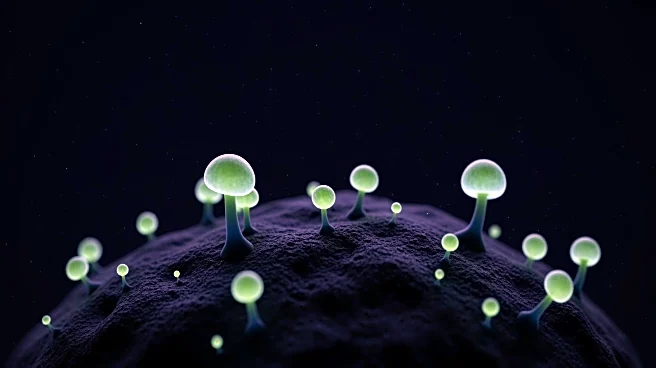
Researchers have discovered that a black fungus, Cladosporium sphaerospermum, found in the Chernobyl Exclusion Zone, has evolved to thrive in high-radiation environments. This fungus, known for its high melanin
content, appears to grow towards radiation, a phenomenon termed 'positive radiotropism.' Scientists are exploring the potential of using this fungus as a self-renewing radiation shield for space travel. The fungus was sent to the International Space Station (ISS) to test its growth and radiation absorption capabilities in a space environment. The experiment showed that the fungus could potentially reduce radiation exposure, as the side of a Petri dish with the fungus recorded fewer radiation counts compared to the control side. This finding suggests that the fungus could be used to develop living radiation shields for spacecraft, potentially reducing the weight and cost of traditional shielding materials.
Why It's Important?
The discovery of Cladosporium sphaerospermum's ability to absorb radiation has significant implications for space exploration. Radiation is a major challenge for long-duration space missions, as it poses health risks to astronauts and can damage spacecraft. Traditional radiation shielding is heavy and expensive to transport. A living shield made from this fungus could offer a lightweight, self-repairing alternative, reducing costs and increasing safety for astronauts. This innovation could facilitate longer missions, such as those to Mars or beyond, by providing a sustainable method of radiation protection. Additionally, the concept of using biological materials for in-situ resource utilization (ISRU) aligns with the broader goal of making space travel more efficient and sustainable.
What's Next?
Further research is needed to confirm the effectiveness and practicality of using Cladosporium sphaerospermum as a radiation shield in space. Future experiments will likely focus on optimizing the growth conditions for the fungus in space and testing its performance in different radiation environments. Researchers may also explore combining the fungus with other materials to create composite shields that offer structural support as well as radiation protection. If successful, this approach could revolutionize the design of spacecraft and habitats for long-term space missions, making them safer and more cost-effective.
Beyond the Headlines
The use of Cladosporium sphaerospermum as a radiation shield raises interesting questions about the role of biological organisms in space technology. This approach could lead to new biotechnological applications in space exploration, such as the development of living materials that can adapt to and thrive in extraterrestrial environments. It also highlights the potential for using Earth's extremophiles—organisms that live in extreme conditions—as models for developing new technologies. This research could pave the way for a new era of bio-inspired engineering, where living systems are integrated into the design of space infrastructure.