



What's Happening?
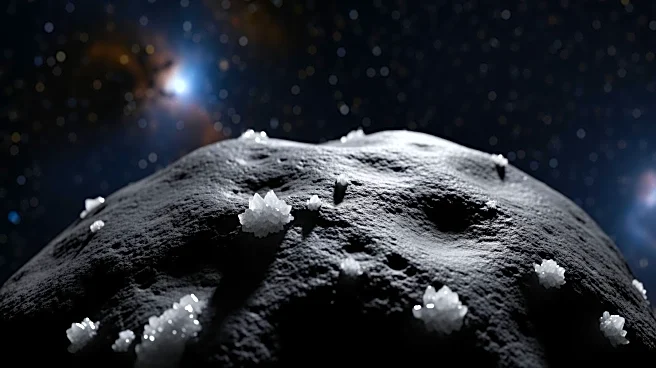
NASA has discovered essential sugars, including ribose and glucose, on the asteroid Bennu, which could provide insights into the origins of life on Earth. These sugars are crucial components of RNA, a molecule believed to have played a key role in the early
development of life. The discovery was made from samples collected by NASA's OSIRIS-REx mission, which returned to Earth in 2023. In addition to sugars, the samples contained a unique 'space gum,' a nitrogen- and oxygen-rich polymer that may have contributed to the formation of life. This finding supports the 'RNA world' hypothesis, suggesting that RNA preceded DNA in the evolution of life.
Why It's Important?
The discovery of life-linked sugars on Bennu is a significant breakthrough in understanding the chemical processes that may have led to the emergence of life on Earth. It provides direct evidence that the building blocks of life could have been delivered to Earth via asteroids, supporting theories about the extraterrestrial origins of life's essential components. This research could reshape our understanding of the early solar system and the conditions that fostered the development of life. Additionally, it highlights the importance of space exploration in uncovering the mysteries of our origins and the potential for life elsewhere in the universe.
What's Next?
Scientists will continue to analyze the samples from Bennu to uncover more about the asteroid's composition and its implications for the origins of life. Further studies may focus on the unique 'space gum' and its role in prebiotic chemistry. The findings could influence future missions aimed at exploring other asteroids and celestial bodies for similar life-linked compounds. As researchers delve deeper into the data, they may refine existing theories about the early solar system and the processes that led to the formation of life on Earth.