





What's Happening?
The U.S. Army conducted a large-scale urban assault training exercise at Fort Irwin in California, involving nearly 10,000 soldiers. This exercise, part of Project Convergence Capstone, simulated a conflict against a formidable peer adversary in a sprawling
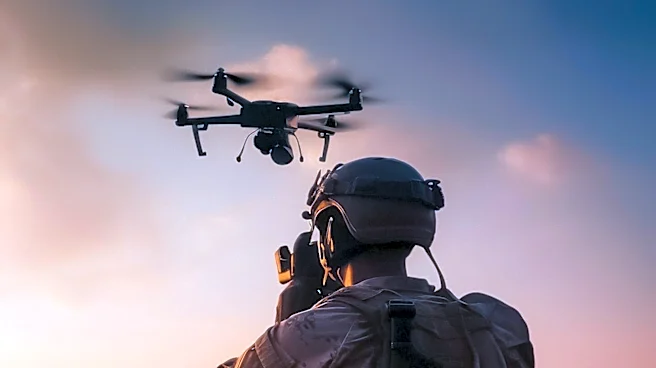
desert city named Razish. The training focused on traditional warfighting skills, such as clearing streets and buildings, while also integrating new technologies like drones and software. Soldiers experimented with uncrewed aerial systems (UAS) for early surveillance, with one unit commander using a Black Widow quadcopter to assess enemy movements. Additionally, troops utilized the prototype Next Generation Command and Control (NGC2), a software- and artificial intelligence-enabled battlefield network, on chest-mounted smartphones to track friendly forces and potential enemy locations. The exercise aimed to evaluate the effectiveness of these new systems in a complex combat scenario.
Why It's Important?
This exercise is crucial for the U.S. Army's modernization efforts, as it directly tests the integration of emerging technologies into combat operations. The ability to effectively incorporate drones and AI-enabled battlefield networks can significantly enhance situational awareness, targeting capabilities, and overall operational efficiency. The focus on urban warfare reflects the evolving nature of global conflicts, where dense urban environments present unique challenges. By experimenting with these technologies in a realistic setting, the Army can identify what works and what doesn't, informing future procurement and training strategies. The feedback gathered from soldiers on the ground, including both successes and connection issues with systems like NGC2, is invaluable for refining these tools before they are deployed in actual combat. This proactive approach ensures that U.S. forces maintain a technological edge against potential adversaries.
What's Next?
The U.S. Army will analyze the feedback and data collected from the Project Convergence Capstone exercise to refine its technological integration strategies. Brig. Gen. Daniel Hibner, head of the Army Joint Modernization Command, emphasized that failures during the exercise are valuable for identifying ineffective systems. This iterative process of testing and evaluation will guide decisions on which experimental systems to further develop and which to discard. Future iterations of Project Convergence will likely see continued experimentation with advanced drones, ground robots, and AI-powered command and control systems, with a focus on seamless integration and user-friendliness for soldiers. The Army will also continue to address challenges such as connectivity issues and the potential for technology to become a distraction rather than an aid in combat, ensuring that traditional warfighting skills remain central while leveraging technological advancements.
Beyond the Headlines
Beyond the immediate military implications, the U.S. Army's integration of advanced technologies in training highlights a broader societal trend towards automation and AI in critical sectors. The challenges faced by soldiers, such as balancing technological reliance with traditional skills and dealing with system failures, mirror issues encountered in civilian applications of AI and robotics. This exercise also underscores the ethical considerations surrounding autonomous systems in warfare, including decision-making processes and accountability. The development of sophisticated battlefield networks like NGC2 could lead to a more interconnected and data-driven military, but it also raises concerns about cybersecurity vulnerabilities and the potential for electronic warfare to disrupt critical communications. Ultimately, the Army's experience in this simulated conflict provides valuable insights into the complex interplay between human capabilities and technological advancements in high-stakes environments.