
What's Happening?
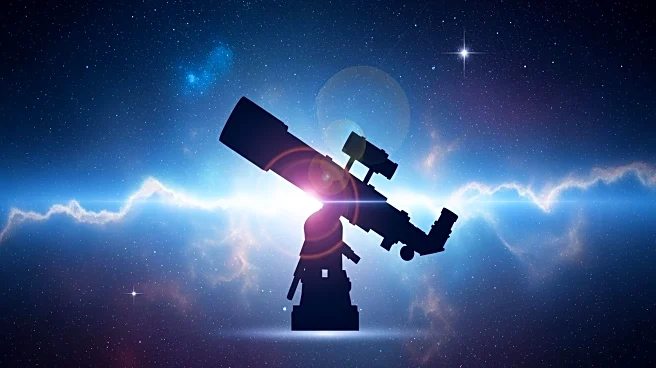
The Hubble Space Telescope, launched on April 24, 1990, is celebrating its 36th anniversary. Initially launched with a flaw in its mirror, Hubble's vision was corrected in 1993, leading to decades of groundbreaking astronomical discoveries. The telescope
has made nearly 1.7 million observations, contributing to over 22,000 scientific papers. Hubble's data has been pivotal in understanding cosmic phenomena such as the expansion of the universe and the existence of exoplanets. Its images have also captured the public's imagination, making it a cultural icon.
Why It's Important?
Hubble's contributions have significantly advanced our understanding of the universe, influencing both scientific research and public interest in space exploration. The telescope's ability to observe distant galaxies and cosmic events has provided insights into the universe's history and structure. Its success has paved the way for future space telescopes, such as the James Webb Space Telescope, which will continue to explore the cosmos. Hubble's legacy demonstrates the importance of investing in scientific research and technology to expand human knowledge.
What's Next?
Hubble will continue its mission, working alongside newer telescopes like the James Webb Space Telescope. Future plans include the development of the Habitable Worlds Observatory, which aims to search for Earth-like planets and signs of life. Hubble's ongoing operations and data collection will remain valuable for astronomers studying the universe's evolution and phenomena. The lessons learned from Hubble's design and maintenance will inform the development of future space observatories.