



What's Happening?
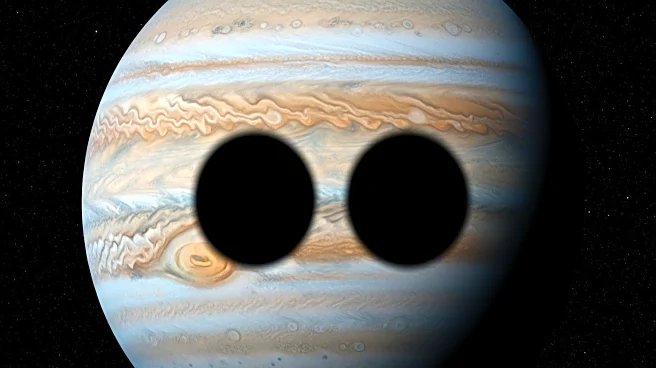
A new simulation led by scientists from the University of Chicago and Jet Propulsion Lab has provided insights into Jupiter's atmosphere, suggesting it contains about 1.5 times more oxygen than the sun. The study, published in The Planetary Science Journal,
utilized advanced chemical and hydrodynamic modeling to analyze the complex interactions within Jupiter's atmosphere. The research addresses longstanding questions about the planet's composition, particularly the amount of water and oxygen present. The findings indicate that Jupiter's atmosphere is more oxygen-rich than previously thought, challenging earlier studies that suggested lower oxygen levels.
Why It's Important?
Understanding Jupiter's atmospheric composition is crucial for piecing together the history of our solar system's formation. The presence of more oxygen than the sun suggests that Jupiter may have formed under different conditions than previously believed. This information can help scientists refine models of planetary formation and evolution, providing insights into the processes that shaped not only Jupiter but also other planets in our solar system. The study's findings could also inform future missions to Jupiter, such as the ongoing Juno mission, by offering a more detailed understanding of the planet's atmospheric dynamics.
What's Next?
The research team plans to continue refining their models to further explore Jupiter's atmospheric composition and dynamics. Future studies may focus on the implications of these findings for the planet's formation and evolution. Additionally, ongoing and upcoming missions to Jupiter, such as Juno, will continue to gather data that can be used to validate and expand upon these results. The study's insights may also influence the search for habitable planets beyond our solar system by providing a better understanding of the conditions necessary for planet formation.