



What's Happening?
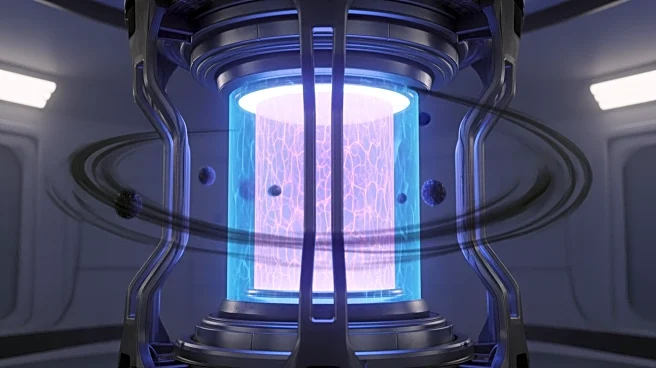
A team of physicists, including University of Cincinnati professor Jure Zupan, has proposed a theoretical method for producing axions, a type of subatomic particle, inside fusion reactors. Axions are believed to be linked to dark matter, which constitutes
a significant portion of the universe's mass but has never been directly observed. The study, published in the Journal of High Energy Physics, explores a fusion reactor design using deuterium and tritium fuel within a lithium-lined vessel. This reactor, part of an international collaboration in France, could generate neutrons that interact with the reactor's walls, potentially creating new particles associated with the dark sector. The research builds on concepts previously explored in popular culture, such as the CBS sitcom 'The Big Bang Theory,' where characters attempted to solve similar theoretical challenges.
Why It's Important?
The study's findings could have profound implications for understanding dark matter, a mysterious component of the universe that influences the motion of galaxies and stars. By potentially producing axions in fusion reactors, scientists may gain new insights into the nature of dark matter and its role in cosmic evolution. This research could pave the way for future experimental efforts to detect dark matter particles, which have eluded direct observation despite their significant gravitational effects. The ability to generate axions in controlled environments like fusion reactors could also advance the development of new technologies and methodologies in particle physics, enhancing our understanding of fundamental forces and the universe's composition.
What's Next?
The next steps involve further theoretical and experimental research to validate the proposed method of axion production in fusion reactors. Scientists may focus on optimizing reactor designs and conducting experiments to detect axions or axion-like particles. Collaboration among international research institutions will be crucial to advancing this field, potentially leading to breakthroughs in dark matter detection. Additionally, the study may inspire new interdisciplinary projects that combine insights from physics, engineering, and cosmology to explore the universe's hidden components.
Beyond the Headlines
The exploration of axion production in fusion reactors highlights the intersection of science and popular culture, as seen in 'The Big Bang Theory.' This connection underscores the broader cultural impact of scientific research and its ability to inspire public interest and understanding. The study also raises ethical considerations regarding the pursuit of knowledge about dark matter and the potential consequences of manipulating fundamental particles. As research progresses, scientists must navigate the balance between scientific discovery and its implications for society and the environment.