



What's Happening?
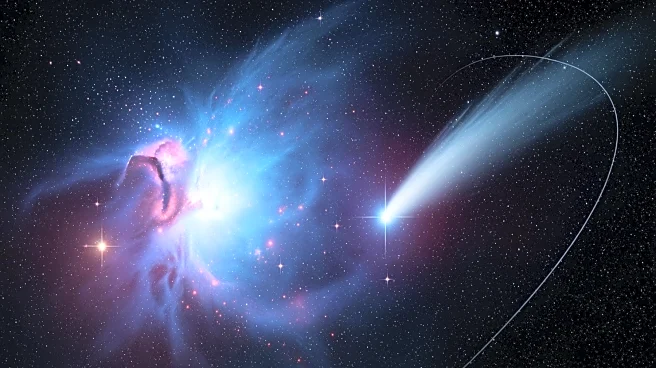
Astronomy enthusiasts have a unique opportunity to observe the Orion Nebula (M42) and Comet Schaumasse in the night sky. The Orion Nebula, a prominent star-forming region with a magnitude of 4.0, is visible as a faint, fuzzy patch below Orion's belt.
It is best observed in the absence of significant lunar illumination. The nebula's intricate gaseous structures and the central Trapezium Cluster, a group of hot, young stars, can be seen through telescopes. These stars' powerful radiation sculpts the surrounding nebular material. Additionally, Comet Schaumasse, estimated at 12th magnitude, will be detectable in the constellation Leo by December 12 at 3 A.M. local time. It will be situated near the background galaxies NGC 3607 and NGC 3608. The article also highlights the opportunity to spot Neptune on December 10, with local astronomical data provided, including sunrise, sunset, and moon phase details.
Why It's Important?
This celestial event offers a significant opportunity for both amateur and professional astronomers to engage with the night sky. Observing the Orion Nebula provides insights into star formation processes and the dynamics of young stellar clusters. The visibility of Comet Schaumasse adds an additional layer of interest, as comets are relatively rare and offer a glimpse into the early solar system's composition. Such events can inspire public interest in astronomy and science, potentially encouraging educational pursuits in these fields. The ability to observe these phenomena without significant lunar interference enhances the experience, making it accessible to a wider audience with varying levels of equipment.
What's Next?
As the observation window for these celestial events is limited, enthusiasts are encouraged to prepare their equipment and plan their viewing sessions accordingly. Clear skies and minimal light pollution will enhance the viewing experience. Astronomy clubs and observatories may organize public viewing events to facilitate community engagement and education. Additionally, astrophotographers may take advantage of this opportunity to capture images of the Orion Nebula and Comet Schaumasse, contributing to the broader scientific and educational community.