




What's Happening?
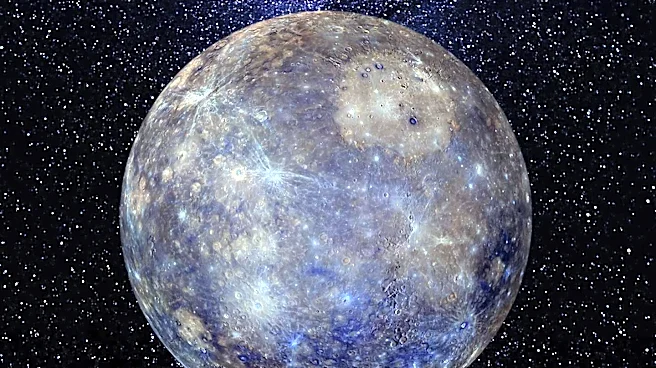
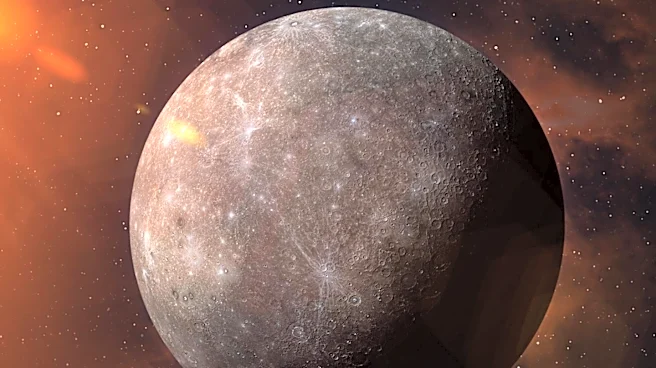
A new study indicates that Mercury, the smallest planet in our solar system, may have shrunk by as much as 7.2 miles (11.6 kilometers) in radius, which is up to 30% more than previous estimates. Scientists, led by Dr. Gaku Nishiyama of the German Aerospace
Center (DLR), suggest that Mercury's heavily cratered surface has concealed a substantial portion of the faults created as the planet cooled and contracted over billions of years. The study, published in Geophysical Research Letters, found that tectonic structures, which are indicators of planetary contraction, were preferentially identified in smoother terrains, while rougher, heavily cratered regions contained fewer detectable structures. This suggests that older structures might have been hidden under impact material or become difficult to discern against the rough topography, leading to an underestimation of the planet's overall shrinkage.
Why It's Important?
This revised estimate of Mercury's contraction is important because it could significantly alter current models of how the planet's interior evolved. The amount of contraction directly constrains key aspects of Mercury's geological history, such as how quickly it lost heat, the thickness of its insulating regolith, the abundance of heat-producing elements, and even the composition and freezing history of its enormous metallic core. A greater degree of shrinkage, as suggested by this study, would favor models involving a thinner regolith and lower sulfur content in Mercury's core than some previous estimates. This research also raises the possibility that scientists may be underestimating the contraction of other rocky worlds, particularly Earth's Moon, which also has a heavily cratered surface. This could lead to a re-evaluation of thermal evolution models for other celestial bodies.
What's Next?
The findings from this study will likely prompt further research and re-evaluation of existing planetary models. The ESA-JAXA BepiColombo mission, with its laser altimeter, is expected to provide much sharper topographic measurements of Mercury, down to scales of about 330 feet (100 meters). These high-resolution data could reveal geological relationships that previous missions, like NASA's MESSENGER, could not resolve, potentially confirming or further refining the new contraction estimates. Researchers will also likely investigate whether similar 'roughness effects' are obscuring evidence of contraction on other celestial bodies, such as the Moon and Mars, which could lead to a broader recalibration of our understanding of rocky planet evolution. Future studies will aim to differentiate between various mechanisms that could be hiding these tectonic features, including burial by impact ejecta, difficulty in detection in rough terrain, or deformation absorbed by porous regolith.
Beyond the Headlines
The study's implications extend beyond Mercury, suggesting a fundamental challenge in planetary geoscience: the more battered and ancient a world's surface, the more effectively it can erase the visible record of its past geological activity. This 'missing wrinkles' problem highlights the complexity of interpreting planetary surfaces and the need for advanced analytical techniques to uncover hidden geological histories. It underscores that our understanding of planetary evolution is constantly being refined as new data and methodologies emerge. This research also subtly points to the limitations of observational data when surface features are obscured, emphasizing the importance of theoretical modeling and sophisticated data processing to infer underlying geological processes. The interdisciplinary nature of this research, combining remote sensing, geological mapping, and thermal modeling, exemplifies the collaborative effort required to unravel the mysteries of our solar system.