

What's Happening?
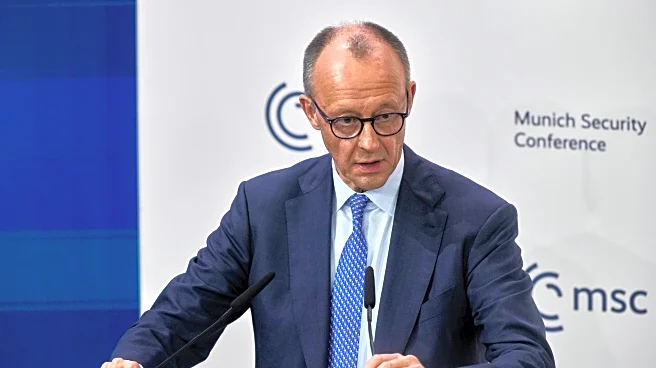
German Chancellor Friedrich Merz has highlighted a growing rift between the United States and Europe, attributing it to culture wars driven by President Trump's MAGA movement. Speaking at the Munich Security Conference, Merz emphasized that this divide
is a significant concern for trans-Atlantic relations. He referenced a previous statement by US Vice President JD Vance, who accused Europe of stifling free speech and democratic rights. Merz called for a renewed trans-Atlantic partnership, stressing that neither the US nor Europe can afford to act alone in an increasingly threatening global environment. The conference also touched on other geopolitical issues, including the ongoing conflict in Ukraine and the need for Europe to maintain a unified stance against Russia.
Why It's Important?
The deepening rift between the US and Europe could have significant implications for international diplomacy and security. As both regions face common threats, such as the rise of authoritarianism and global instability, a fractured alliance could weaken their collective ability to respond effectively. The call for a new trans-Atlantic partnership underscores the importance of collaboration in addressing global challenges. This development may also influence US foreign policy, particularly in how it engages with European allies. The cultural and political differences highlighted by Merz could lead to shifts in diplomatic strategies and impact international trade, security agreements, and global governance.
What's Next?
Moving forward, efforts to repair and strengthen US-Europe relations will be crucial. Diplomatic initiatives may focus on finding common ground on contentious issues such as free speech and democratic values. The Munich Security Conference could serve as a platform for further dialogue and negotiation. Additionally, the US and Europe may explore new frameworks for cooperation, particularly in areas like defense and economic policy. The outcome of these discussions could shape the future of trans-Atlantic relations and influence global power dynamics.