


What's Happening?
China has announced the postponement of its ambitious Chang'e-7 lunar mission, which was originally scheduled to launch in the coming days from the Wenchang Space Launch Site on Hainan island. The China Manned Space Agency stated that the mission does
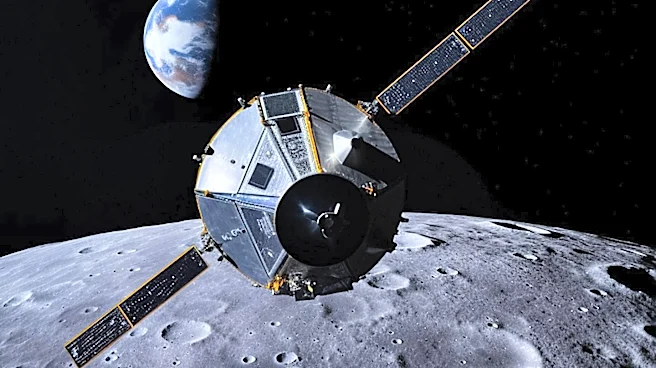
not meet the necessary launch conditions and therefore cannot proceed during its planned window this year. The decision was made after a comprehensive assessment, adhering to principles of prudence, reliability, and ensuring absolute mission success. The Chang'e-7 mission is the seventh in China's lunar exploration program and was intended to explore permanently shadowed craters on the Moon, conduct environmental and resource surveys of the lunar South Pole, and search for water ice. The mission includes an orbiter, a lander, a mini-hopping probe, and a rover, making it China's most complex single lunar mission to date.
Why It's Important?
The postponement of the Chang'e-7 mission is significant for China's ambitious lunar exploration roadmap and the broader international 'moon race.' This mission was designed to make critical breakthroughs in key technologies and gather essential data on the lunar South Pole, a region of high scientific and strategic interest due to the potential presence of water ice. Delays in such high-profile missions can impact the overall timeline for China's long-term goals, including the establishment of the International Lunar Research Station (ILRS) by 2035 and a crewed lunar landing before 2030. The emphasis on 'absolute mission success' underscores the high stakes involved in lunar exploration and the rigorous standards applied to these complex endeavors. Any setback in China's lunar program could influence the competitive dynamics with other spacefaring nations, including the United States, in the race to establish a sustained presence on the Moon.
What's Next?
The China Manned Space Agency has not provided a new launch date for the Chang'e-7 mission, only stating that it cannot take place within the planned window this year. The agency will likely conduct further assessments and address the unmet launch conditions before rescheduling. This delay could potentially push back subsequent missions in China's lunar program, such as Chang'e-8, which is designed to test in-situ resource utilization technologies. The international space community will be closely watching for updates, as the mission's data on water ice and the lunar South Pole environment is crucial for all nations planning lunar activities. The postponement also highlights the inherent challenges and complexities of space launches, where even minor issues can lead to significant delays to ensure mission safety and success.
Beyond the Headlines
The decision to postpone Chang'e-7, despite extensive preparations, reflects a cautious approach to space exploration, prioritizing mission success over adherence to a strict timeline. This prudence is particularly relevant given the high costs and risks associated with lunar missions. The mission's focus on the lunar South Pole and the search for water ice underscores the global consensus on the strategic importance of this region for future lunar settlements and resource extraction. The data from Chang'e-7 would have contributed significantly to understanding the feasibility of utilizing lunar resources, which could revolutionize long-duration space missions by reducing reliance on Earth-supplied materials. The delay, while a setback, also provides an opportunity for further refinement of technologies and procedures, potentially enhancing the mission's ultimate success and scientific yield.