

What's Happening?
The Paul Revere House, in partnership with GBH, Suffolk University History Department, and the Museum of Fine Arts, will host a lecture titled 'Piece by Piece: Crazy Quilting and Making Memory in 19th-Century Massachusetts' on October 26. The event, part of the 2026
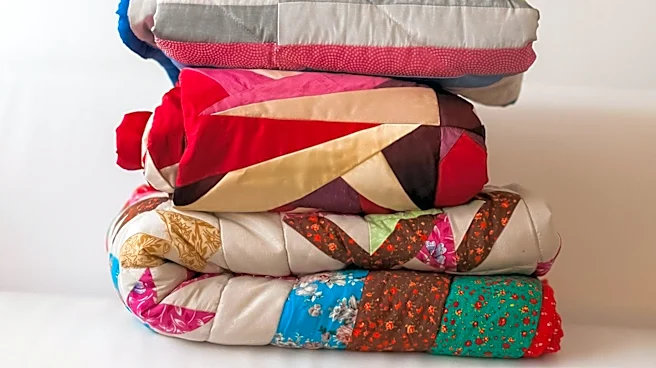
Lowell Lecture Series, will feature Tenesha Carter Johnson, a curator and cultural historian specializing in American quilt and textile histories. Johnson's presentation will explore how 19th-century women used 'crazy' quilting as a method of creating personal archives, weaving scraps of fabric and keepsakes into intricate mosaics that recorded their lived experiences and memories. The lecture will delve into the significance of the hundreds of hours of labor invested in these quilts and what they reveal about the relationship between memory and material culture. The event is free to the public and will be held in person at Smith Commons, Sargent Hall, Suffolk University, and also available online.
Why It's Important?
This lecture offers a unique insight into the social and cultural history of 19th-century Massachusetts, particularly focusing on the often-overlooked contributions and experiences of ordinary women. By examining crazy quilting, the event highlights how domestic crafts served as significant forms of artistic expression, personal record-keeping, and historical intervention. For U.S. audiences, it provides a deeper understanding of American material culture and the ways in which everyday objects can convey rich narratives about the past. The lecture's focus on quilts as 'personal archives' underscores the importance of non-traditional historical sources and challenges conventional notions of historical documentation. It also connects to broader themes of craft, labor, and memory, demonstrating how these elements shaped the lives of individuals and communities in a specific historical period. The involvement of institutions like the Smithsonian National Museum of African American History & Culture in Johnson's research further emphasizes the academic and cultural relevance of this topic.
What's Next?
The lecture is part of the ongoing 2026 Lowell Lecture Series, 'Engrave, Paint, Sew, Weave: Craft and Craftspeople in Massachusetts,' which aims to explore various local and regional craft histories inspired by Paul Revere's legacy as an artisan. Following this event, the series will continue to delve into other craft traditions, with lectures scheduled on Mondays, September 14 and 28, and October 05 and 26. The lectures are recorded and made available after the fact, ensuring broader access to the historical and cultural insights shared. This ongoing series suggests a sustained effort by the Paul Revere House and its partners to promote public understanding of craft's role in American history and its connection to local identities and resources. Attendees and online viewers can anticipate further explorations into the diverse world of Massachusetts craftspeople and their impact on the region's cultural heritage.
Beyond the Headlines
The study of crazy quilting, as presented in this lecture, extends beyond mere textile history to touch upon profound aspects of human experience, such as the construction of identity, the preservation of personal narratives, and the emotional resonance of material objects. These quilts, often made from sentimental scraps, embody a form of 'slow history,' where the passage of time and the accumulation of memories are literally stitched together. This practice can be seen as a precursor to modern scrapbooking or digital archiving, highlighting a timeless human need to document and remember. Furthermore, the lecture implicitly addresses themes of resourcefulness and creativity within domestic spheres, showcasing how women, often confined to these spaces, found innovative ways to express themselves and leave a tangible legacy. The 'crazy' nature of these quilts, with their unconventional patterns and varied textures, can also be interpreted as a subtle form of rebellion against rigid societal norms, allowing for individual expression within a structured craft. This deeper dive into the craft reveals not just historical artifacts, but powerful testaments to individual lives and collective memory.