
What's Happening?
A Chinese research team has successfully captured the first direct evidence of the Migdal effect, a significant breakthrough in the field of particle physics with implications for dark matter research.
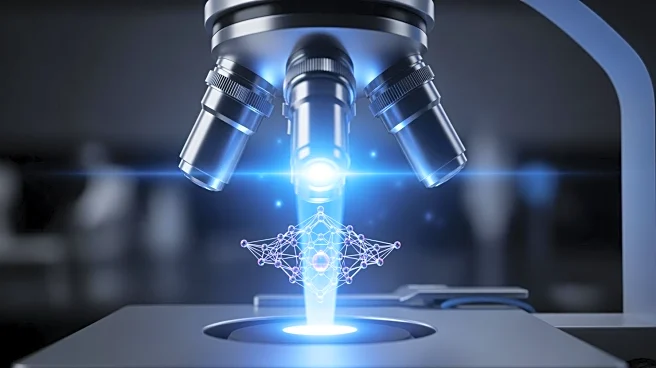
The Migdal effect, predicted by Soviet physicist Arkady Migdal in 1939, occurs when an atomic nucleus gains energy and recoils, causing a rapid shift in the atom's internal electric field that can eject one of its orbiting electrons. This discovery was made using a specialized 'atomic camera'—a high-precision gas detector integrated with a custom-designed microchip—capable of tracking the trajectory of a single atom and the electron it releases. The team identified six clear signals displaying the Migdal effect's defining signature, achieving a statistical confidence of the five-sigma threshold, the gold standard in particle physics.
Why It's Important?
The discovery of the Migdal effect opens new avenues for dark matter research, particularly in the search for light dark matter particles. Traditional dark matter searches have focused on WIMPs, or weakly interacting massive particles, but have yielded no evidence. The Migdal effect allows for the detection of lighter dark matter particles by converting an otherwise imperceptible low-energy jolt into a measurable electronic signal. This breakthrough fills a long-standing experimental gap and solidifies the theoretical foundation of the Migdal effect, potentially revolutionizing the approach to dark matter detection and expanding the scope of particle physics research.
What's Next?
The research team plans to optimize the detector's performance and extend observations of the Migdal effect to other elements. This will provide essential data to support the search for even lighter dark matter particles. The team aims to study the Migdal effect using different target materials, which could further enhance the understanding and detection capabilities of dark matter particles. These efforts are expected to contribute significantly to the field of particle physics and the ongoing quest to unravel the mysteries of dark matter.