
What's Happening?
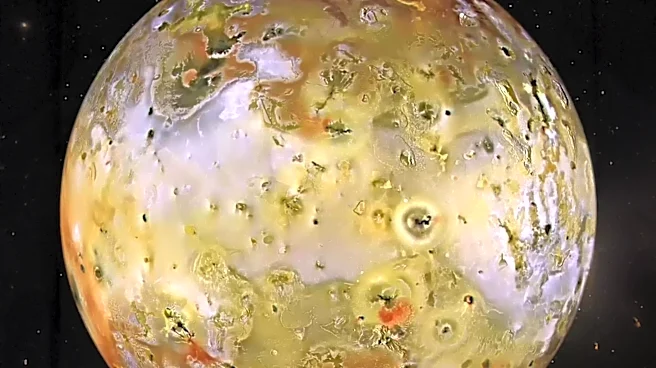
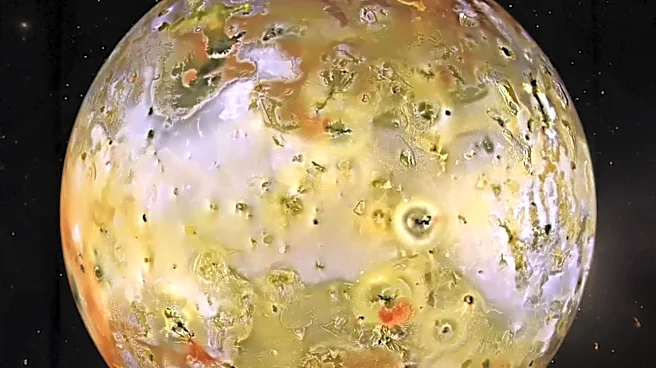
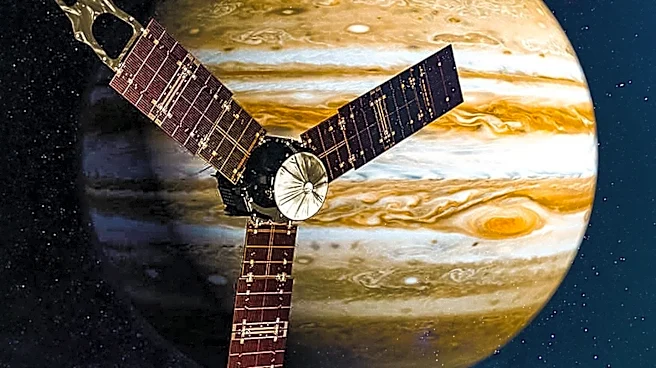
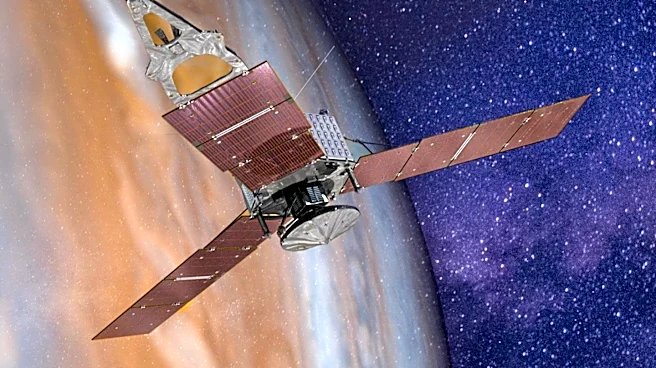
NASA's Juno spacecraft has provided new insights into the subsurface temperatures of Jupiter's moon Io, the most volcanically active world in the solar system. During close flybys in late 2023 and early
2024, Juno used its Microwave Radiometer (MWR) instrument to probe beneath Io's surface, revealing how heat moves through its crust. The findings showed temperatures rising significantly just a few feet below the surface, far more than sunlight alone could explain. The data also revealed localized regions of elevated heat, suggesting the presence of porous layers of volcanic ash and sulfur frost. These observations offer a new way to study planetary crusts and could transform how scientists understand volcanoes across the solar system.
Why It's Important?
The discovery of subsurface heat on Io is crucial for understanding volcanic activity on other planets, including Earth. By revealing how heat moves through Io's crust, Juno's observations provide valuable data that could improve eruption forecasting and monitoring of Earth's volcanoes. The findings also offer insights into tidal heating, a process that generates internal heat and fuels volcanic activity. This knowledge could aid the search for life on other moons, such as Europa and Ganymede, where subsurface oceans may exist. Understanding how heat moves through planetary crusts is key to determining the potential for life in these environments.
What's Next?
NASA's Juno mission will continue to study Io and other moons of Jupiter, using its instruments to gather more data on subsurface temperatures and volcanic activity. The insights gained from Io could lead to new techniques for monitoring Earth's volcanoes and predicting eruptions. Researchers will also explore the implications of tidal heating for other celestial bodies, potentially uncovering new environments suitable for life. Future missions may focus on probing beneath icy surfaces to study subsurface oceans and their potential for harboring life.
Beyond the Headlines
Juno's observations of Io highlight the importance of studying planetary crusts to understand volcanic activity and heat transfer. The findings could lead to advancements in geophysical research and improve the monitoring of volcanic activity on Earth. The study of tidal heating on Io provides a unique opportunity to learn about energy and heat generation in distant worlds, offering insights into the dynamics of planetary systems. These discoveries may also influence the search for life beyond Earth, as understanding heat movement is crucial for identifying habitable environments.