




What's Happening?
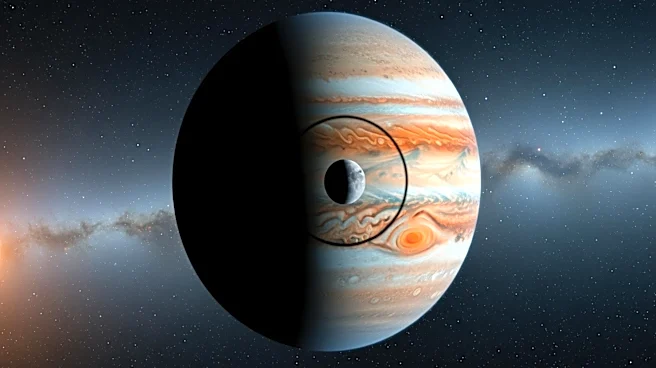
On April 13, 2026, a notable celestial event involving Jupiter's moons Io and Europa is observable across the United States. Shortly after midnight Central Daylight Time, Io stands just a few arcseconds north of Europa, while Europa's shadow transits
Jupiter's disk. This event is part of a series of movements by the Galilean moons, showcasing the orbital mechanics of the solar system's largest planet. As twilight fades, Europa begins its transit across Jupiter, visible from the middle of the U.S. Io, moving eastward, crosses paths with Europa, and later disappears behind Jupiter in an occultation. This event is visible for the western two-thirds of the U.S., providing a unique opportunity for sky watchers to observe the dynamic interactions of Jupiter's moons.
Why It's Important?
This celestial event is significant for both amateur and professional astronomers as it provides a rare opportunity to observe the intricate dance of Jupiter's moons. Such events help in understanding the gravitational interactions and orbital dynamics of celestial bodies. For the general public, it offers a chance to engage with astronomy and appreciate the complexities of our solar system. The visibility of this event across a large portion of the U.S. makes it accessible to a wide audience, potentially sparking interest in space science and observation.
What's Next?
Following this event, astronomers and enthusiasts may continue to track the movements of Jupiter's moons, as these interactions can provide further insights into their orbits and the gravitational influences at play. Observatories and space agencies might use data from such events to refine models of celestial mechanics. Public interest generated by this event could lead to increased participation in astronomy clubs and educational programs focused on space science.