


What's Happening?
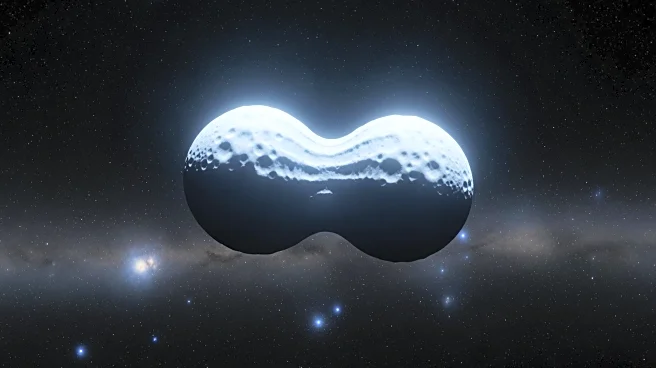
Astronomers have long been puzzled by the presence of peanut-shaped objects in the Kuiper Belt, a region beyond Neptune filled with icy debris. These objects, often referred to as 'space snowmen,' are characterized by their bilobate or 'contact binary'
shapes, where two lobes are fused together. A recent study published in the Monthly Notices of the Royal Astronomical Society offers a new explanation for their formation. Researchers from Michigan State University, including Jackson Barnes, used computer simulations to replicate the early solar system's conditions. They found that these shapes likely formed from a gentle gravitational collapse of debris clouds, rather than violent collisions. This process allowed two small planetesimals to slowly drift together and merge into a single unit, creating the distinctive double-lobed structure. The study suggests that about 10% of objects in the Kuiper Belt may have this shape, indicating that the formation process is not rare.
Why It's Important?
The discovery of how these peanut-shaped objects form provides significant insights into the early solar system's dynamics and the processes that shaped it. Understanding the formation of these objects helps scientists piece together the history of our solar system and the forces at play during its formation. The findings challenge previous assumptions that such shapes were the result of random collisions, instead highlighting the role of gentle gravitational interactions. This research could influence future studies on planetary formation and the evolution of celestial bodies. Additionally, the prevalence of these shapes in the Kuiper Belt suggests that similar processes might occur in other star systems, offering a broader perspective on planetary formation across the universe.
What's Next?
Future research will likely focus on further exploring the Kuiper Belt to identify more of these peanut-shaped objects and understand their distribution. There is potential for new deep-space missions to gather more data on these distant objects, which could provide additional evidence to support the current findings. As technology advances, astronomers may be able to observe these objects in greater detail, leading to a deeper understanding of their composition and the conditions that led to their formation. The study also opens up new questions about the complexity of the Kuiper Belt and the potential for discovering other unique shapes and structures within it.
Beyond the Headlines
The study of these peanut-shaped objects in the Kuiper Belt not only sheds light on the past but also raises questions about the future of space exploration. The findings highlight the importance of continued investment in space research and the development of advanced technologies to explore the outer reaches of our solar system. The research also underscores the interconnectedness of celestial phenomena, as understanding these distant objects can provide insights into the processes that may occur in other parts of the universe. This knowledge could have implications for the search for extraterrestrial life and the study of exoplanets, as similar formation processes might be at work in other star systems.