



What's Happening?
The Trump administration's Department of Energy (DOE) has significantly shifted its focus from decarbonization to expanding reliable electricity generation and grid capacity, according to Curt Coccodrilli, Assistant Secretary for the U.S. Department of Energy’s
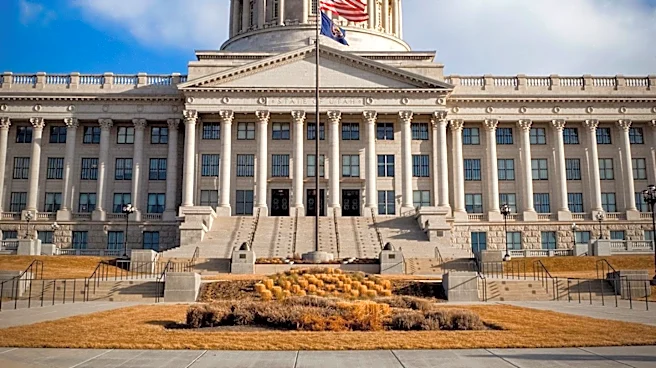
Hydrocarbons and Geothermal Energy Office. Coccodrilli, during a visit to Utah, highlighted the state's abundant coal, geothermal, nuclear, and other energy resources as crucial opportunities to increase power supply and reduce electricity costs. He noted that the current administration's energy goals are "hyper-focused on adding electrons to the grid, not subtracting," a stark contrast to the previous administration's emphasis on the Green New Deal. President Trump declared a national emergency on his first day in office, citing an insufficient energy supply. In response, the DOE has prevented 45 coal plants, generating over 40 gigawatts, from going offline this year.
Why It's Important?
This strategic shift by the DOE under the Trump administration has profound implications for the U.S. energy landscape and economy. By prioritizing baseload power sources like coal, oil, gas, nuclear, and geothermal, the administration aims to enhance energy security and affordability across the nation. This approach directly challenges previous policies that favored rapid decarbonization, potentially leading to a resurgence in traditional energy sectors and associated job growth in states rich in these resources, such as Utah. The focus on increasing electricity supply is intended to address rising energy costs, which disproportionately affect states with policies mandating carbon-free electricity. The administration's stance suggests a belief that a robust and affordable energy supply is paramount for economic stability and growth, potentially benefiting industries reliant on consistent and inexpensive power.
What's Next?
The DOE's continued emphasis on expanding baseload power means that states like Utah can expect increased federal support and investment in their energy sectors, particularly in coal, geothermal, and potentially nuclear projects. Coccodrilli predicts that geothermal energy could become a major power source for Utah, potentially powering data centers by 2030, given the state's unique geology. The administration will likely continue to advocate for policies that encourage the extraction and utilization of domestic energy resources, potentially influencing state-level energy policies and regulations. The long-term impact will depend on the sustained implementation of these policies and the market's response to increased supply and potentially lower electricity costs. The debate between energy affordability and environmental concerns is expected to continue, shaping future energy policy decisions.
Beyond the Headlines
The Trump administration's energy policy reflects a broader ideological shift away from environmental regulations that were perceived to hinder economic growth and energy independence. By championing traditional energy sources and emphasizing "adding electrons to the grid," the administration is signaling a return to a more resource-extraction-focused approach. This perspective views energy abundance as a national security imperative and a key driver of economic competitiveness. The focus on affordability, particularly in contrast to states with higher electricity prices linked to carbon-free mandates, highlights a political dimension to energy policy, where energy costs are framed as a critical issue for the average American. This approach also underscores the ongoing tension between federal energy directives and state-level environmental goals, potentially leading to conflicts over resource management and environmental protection.