
What's Happening?
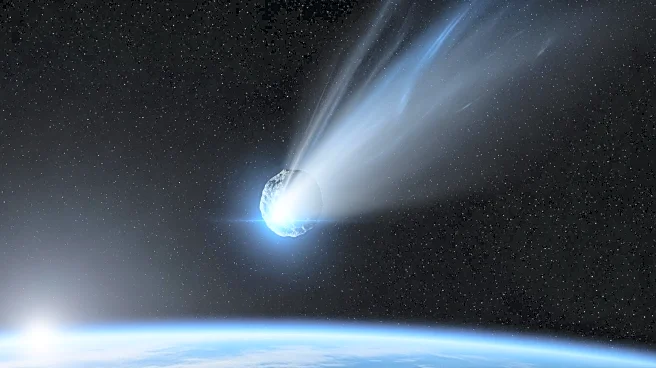
NASA's Hubble Space Telescope has captured images of the interstellar comet 3I/ATLAS, which is set to make its closest approach to Earth on December 19, 2025. The comet was first detected on July 1, 2025,
by the ATLAS survey telescope in Chile. At its closest, the comet will be approximately 170 million miles from Earth, posing no threat. Traveling at a speed of 130,000 miles per hour, 3I/ATLAS is noted as the fastest recorded visitor to the solar system. This comet is the third known interstellar object to pass through the galaxy, making it a significant subject of scientific interest. Researchers have been studying its size and physical properties to better understand its interstellar nature.
Why It's Important?
The passage of comet 3I/ATLAS offers a unique opportunity for scientists to study an interstellar object, which can provide insights into the composition and behavior of celestial bodies from outside our solar system. This event is significant for the scientific community as it helps in understanding the dynamics of interstellar objects and their interactions with our solar system. The data collected could enhance knowledge about the origins and evolution of such objects, potentially impacting theories about the formation of the solar system and the universe. Additionally, the comet's high velocity and trajectory offer a rare chance to observe and analyze an object that has traveled from another star system.
What's Next?
Following its closest approach to Earth, comet 3I/ATLAS will continue its journey through the solar system, heading towards Jupiter and expected to pass its orbit by spring 2026. Scientists will continue to monitor the comet's path and gather data to improve understanding of near-Earth objects. This ongoing observation will aid in developing strategies for tracking and potentially mitigating threats from similar objects in the future. The scientific community is likely to publish findings from this event, contributing to the broader field of astronomy and interstellar studies.