






What's Happening?
Interior Secretary Doug Burgum has signed a Secretarial Order directing the Department of the Interior and the Bureau of Land Management (BLM) to enhance grazing access, promote healthy rangelands, and help mitigate catastrophic wildfires on public lands.
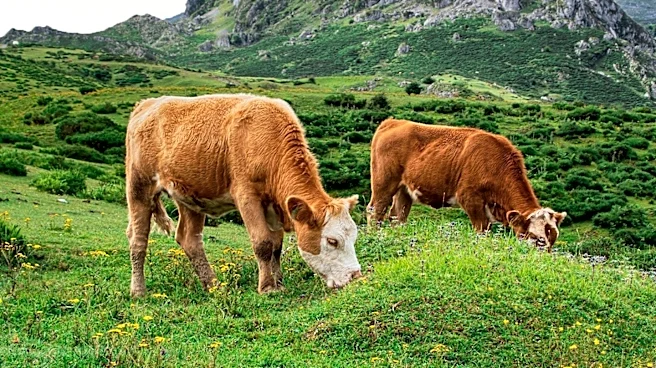
This directive is supported by the National Cattlemen’s Beef Association (NCBA) and the Public Lands Council (PLC), who advocate for streamlining grazing access to improve the health of rangelands and pasturelands. The organizations also believe this move will allow for the full utilization of vacant grazing lands, thereby assisting ranchers in their efforts to rebuild the U.S. cattle herd. NCBA President-elect and Idaho grazing permittee Kim Brackett highlighted that ranchers consistently work to improve rangeland health and manage fuel loads that contribute to wildfires, but have faced significant bureaucratic obstacles in utilizing available forage. This Secretarial Order aims to streamline permitting processes, enabling ranchers to access these previously neglected areas and undertake important voluntary conservation work. This announcement aligns with the October 2025 Grazing Action Plan and a Memorandum of Understanding between the Department of the Interior and the U.S. Department of Agriculture, signed earlier this year, which seeks to improve coordination for federal lands grazing programs.
Why It's Important?
This Secretarial Order holds significant importance for the U.S. cattle industry and the management of public lands. By increasing grazing access and streamlining permitting, it directly addresses a long-standing concern of ranchers regarding the underutilization of available forage on public lands. This initiative is expected to provide much-needed support for rebuilding the U.S. cattle herd, which is currently at a 75-year low. Healthier rangelands, maintained through managed grazing, can also contribute to reducing the risk and severity of catastrophic wildfires, a critical environmental and public safety issue in many Western states. The collaboration between the Department of the Interior and the USDA, as evidenced by the Memorandum of Understanding, signifies a more coordinated approach to federal land management, which could lead to more efficient and effective programs. For ranchers, this order means reduced 'red tape' and greater flexibility in managing their livestock, potentially improving their economic viability and encouraging sustainable land stewardship practices.
What's Next?
Following the signing of the Secretarial Order, the Department of the Interior and the Bureau of Land Management will proceed with implementing the directives to increase grazing access and streamline permitting processes. This will likely involve reviewing and revising existing regulations and procedures to facilitate easier access for ranchers to vacant grazing allotments. The NCBA and PLC anticipate that the components of this order will translate into regulatory improvements, including the much-anticipated revision of BLM grazing regulations. Ranchers across the West will be looking to see how quickly and effectively these changes are put into practice, allowing them to utilize important forage and engage in conservation efforts. The ongoing coordination between the Department of the Interior and the USDA will be crucial in ensuring the seamless operation of federal lands grazing programs and achieving the stated goals of rangeland health improvement and cattle herd rebuilding.
Beyond the Headlines
Beyond the immediate benefits to ranchers and rangeland health, this Secretarial Order reflects a broader philosophical shift in federal land management, emphasizing collaboration with stakeholders like the cattle industry. It acknowledges the role that managed grazing can play not only in supporting agricultural livelihoods but also in ecological restoration and wildfire prevention. This approach moves beyond a purely preservationist model to one that integrates human activity as a tool for environmental management. The order also highlights the ongoing tension between various uses of public lands and the effort to find common ground among different interest groups. By empowering ranchers as partners in land management, the Department of the Interior is signaling a commitment to practical, on-the-ground solutions that leverage local expertise. This could set a precedent for future public land policies, fostering a more integrated and adaptive management framework that balances economic, environmental, and social considerations.