
What's Happening?
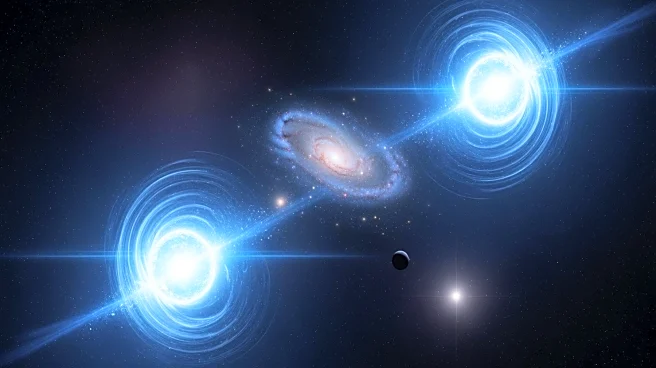
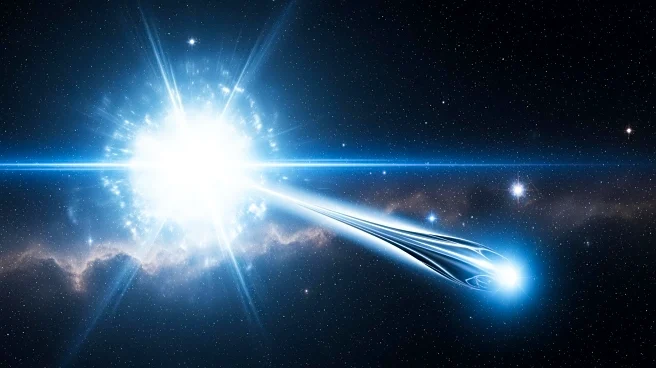
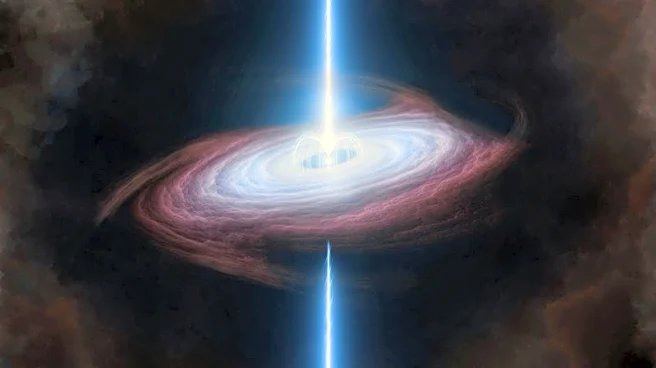
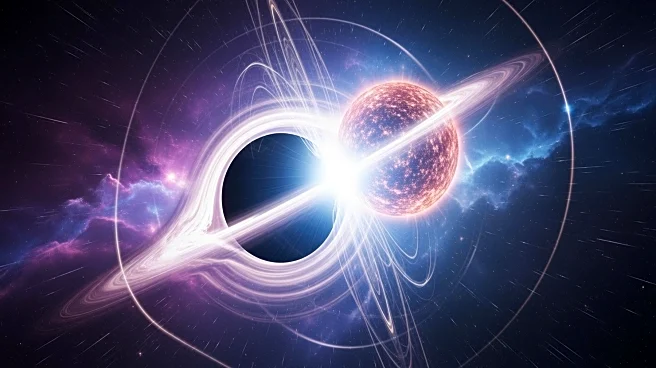
A recent collision between a black hole and a neutron star has revealed a unique orbital interaction, prompting scientists to reconsider existing theories about such cosmic events. The collision, observed through gravitational waves detected by LIGO and Virgo
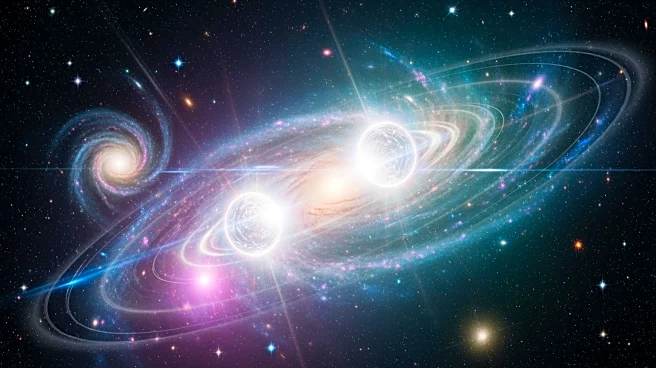
observatories, showed the two objects orbiting each other in an eccentric, oval shape before merging. This finding contradicts the prevailing assumption that these systems form in perfectly circular orbits. The study, published in The Astrophysical Journal Letters, suggests that the system's orbit was influenced by gravitational interactions with other stars or a third companion, rather than evolving in isolation.
Why It's Important?
This discovery challenges the current understanding of how black hole-neutron star systems form and evolve. The eccentric orbit observed in this case indicates that these systems may be shaped by external gravitational forces, rather than following a predictable path to collision. This insight opens new avenues for research into the dynamics of such systems and their formation processes. Understanding these interactions is crucial for refining models of cosmic mergers and improving predictions of gravitational wave events, which have significant implications for astrophysics and our comprehension of the universe.
What's Next?
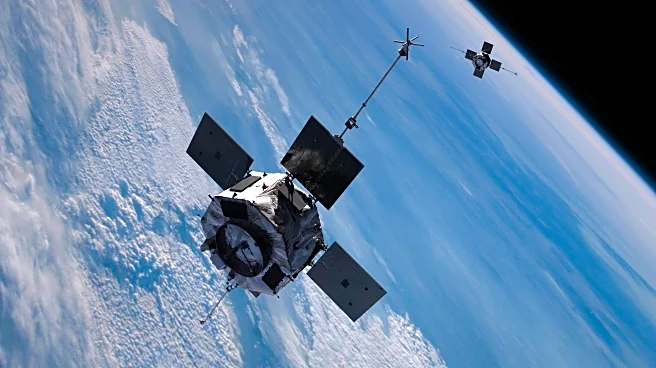
Further research is needed to explore the mechanisms behind the observed eccentric orbit and to identify other systems with similar characteristics. Scientists aim to develop new models that account for these findings and to use upcoming gravitational wave detectors, like the Laser Interferometer Space Antenna (LISA), to detect more unusual signals. These efforts will enhance our understanding of cosmic mergers and the forces that shape them, potentially leading to groundbreaking discoveries in astrophysics. The study highlights the importance of continuous observation and analysis to uncover the complexities of the universe.