



What's Happening?
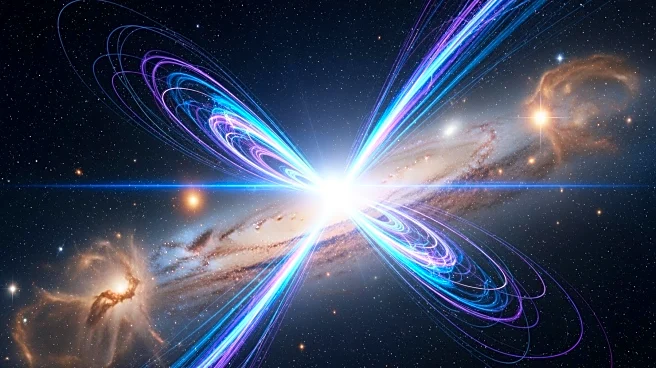
Astronomers using the W. M. Keck Observatory have discovered a galaxy-wide wobbling black hole jet in the disk galaxy VV 340a. This finding reveals the largest and most extended stream of super-heated gas ever observed, stretching up to 20,000 light-years
from the galaxy's center. The discovery challenges existing theories about galaxy evolution, as such jets are typically found in older, elliptical galaxies, not in young, star-forming spiral galaxies like VV 340a. The research, led by the University of California, Irvine, and the California Institute of Technology, highlights the potential for similar phenomena in galaxies like the Milky Way.
Why It's Important?
This discovery has significant implications for our understanding of galaxy and black hole evolution. It suggests that supermassive black holes can have a more profound impact on their host galaxies than previously thought, potentially altering star formation rates and galaxy structure. The findings could lead to a reevaluation of how galaxies like the Milky Way might evolve and interact with their central black holes. This research opens new avenues for studying the dynamic processes within galaxies and the role of black holes in shaping the universe.
What's Next?
Researchers plan to conduct deeper, higher-resolution radio observations to explore the possibility of a second supermassive black hole causing the jet's wobble. This could be a step toward identifying a binary black hole system, which would further enhance our understanding of galaxy dynamics. Continued collaboration between observatories will be crucial in uncovering more about these phenomena and their frequency in the universe.