
What's Happening?
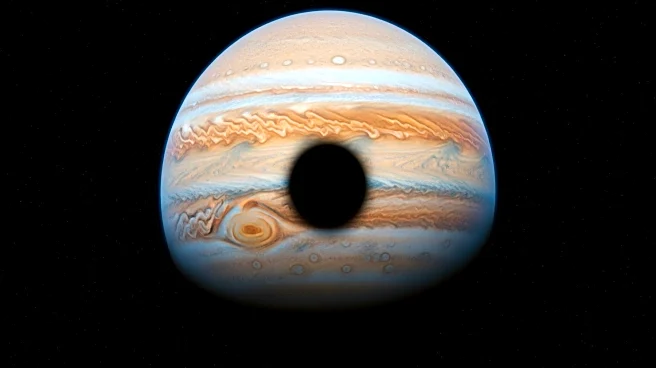
Astronomy Magazine has detailed a celestial event occurring on December 27, 2025, where Io, one of Jupiter's moons, and its shadow will transit across Jupiter's disk. This event is part of a broader observation
guide for the constellation Auriga, which is visible in the eastern sky after sunset. The article provides guidance on locating the open cluster M38, which is part of the 'Happy Face' asterism, a pattern of stars that resembles a smiling face. The article also mentions the nearby open cluster M36, offering amateur astronomers a chance to observe these celestial formations using binoculars or a telescope.
Why It's Important?
This celestial event is significant for astronomy enthusiasts and educators, as it provides an opportunity to observe the dynamic interactions within our solar system. The transit of Io and its shadow across Jupiter offers a visual spectacle that can enhance public interest in astronomy and space science. Such events can inspire educational programs and public outreach efforts, encouraging more people to engage with astronomy. Additionally, these observations contribute to our understanding of planetary movements and the characteristics of celestial bodies, which are crucial for scientific research and exploration.
What's Next?
Following this event, astronomy enthusiasts can look forward to more celestial observations as detailed in Astronomy Magazine's 'Sky This Week' column. The magazine provides ongoing guidance for observing various astronomical phenomena, helping both amateur and professional astronomers plan their observations. Future events may include other planetary transits, meteor showers, and the visibility of different constellations, offering continuous opportunities for engagement with the night sky.
Beyond the Headlines
The observation of celestial events like Io's shadow crossing Jupiter can have broader implications for cultural and scientific communities. It highlights the importance of preserving dark skies for astronomical observations, which can be threatened by light pollution. This event also underscores the role of amateur astronomers in contributing to scientific knowledge, as their observations can complement professional research. Furthermore, such events can foster a sense of wonder and curiosity about the universe, encouraging a deeper appreciation for the natural world.