



What's Happening?
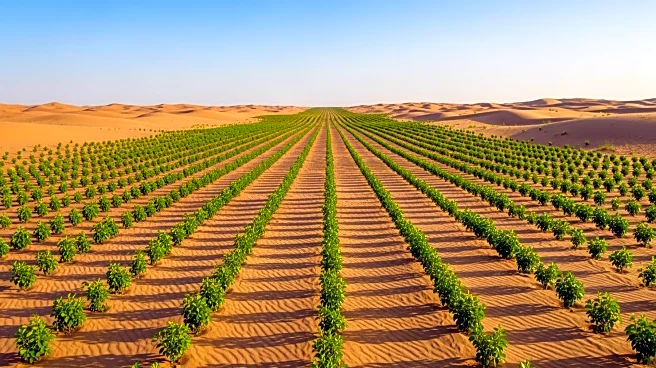
Recent research has highlighted a significant environmental transformation in the Taklamakan Desert, located in northwest China. Through a massive afforestation initiative, known as the Great Green Wall, China has planted over 66 billion trees around
the desert's periphery. This effort has turned the once barren landscape into a thriving carbon sink, capable of absorbing more carbon dioxide than it emits. The study, published in the Proceedings of the National Academy of Sciences, reveals that human intervention can effectively enhance carbon sequestration in extreme arid landscapes. The initiative, which began in 1978 as part of China's Three-North Shelterbelt Program, aimed to combat desertification and improve agricultural productivity. Over the years, the program has successfully stabilized sand dunes and increased vegetation, significantly boosting the region's carbon absorption capacity.
Why It's Important?
The transformation of the Taklamakan Desert into a carbon sink is a groundbreaking development in the fight against climate change. It demonstrates the potential of human-led ecological interventions to reverse desertification and enhance carbon sequestration. This success story provides a model for other desert regions worldwide, offering hope for similar environmental restoration projects. The initiative not only addresses environmental concerns but also has socio-economic implications, as it helps protect agricultural productivity and livelihoods in northern China. By increasing forest cover and stabilizing the desert, the project contributes to global efforts to reduce atmospheric carbon levels, aligning with broader climate change mitigation goals.
What's Next?
The success of the Great Green Wall initiative in the Taklamakan Desert may inspire similar projects in other arid regions facing desertification challenges. As the project continues, further research and monitoring will be essential to understand the long-term impacts on carbon sequestration and ecosystem restoration. Policymakers and environmental organizations may look to replicate this model in other parts of the world, potentially leading to increased international collaboration on afforestation and climate change mitigation efforts. The ongoing expansion of vegetation in the region will require sustained investment and management to ensure its continued success and adaptation to changing environmental conditions.
Beyond the Headlines
The transformation of the Taklamakan Desert into a carbon sink raises important questions about the role of human intervention in natural ecosystems. While the project has achieved significant environmental benefits, it also highlights the complexities of managing large-scale ecological engineering efforts. Ethical considerations regarding the alteration of natural landscapes and the potential impacts on local biodiversity must be addressed. Additionally, the initiative underscores the importance of integrating scientific research with policy and community engagement to achieve sustainable environmental outcomes. As the global community seeks innovative solutions to climate change, the lessons learned from this project could inform future strategies for balancing ecological restoration with socio-economic development.