
What's Happening?
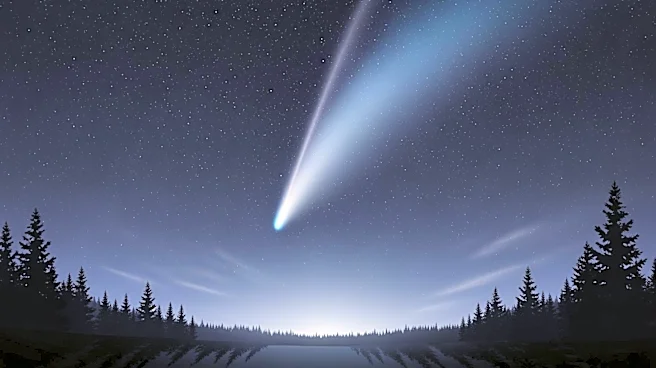
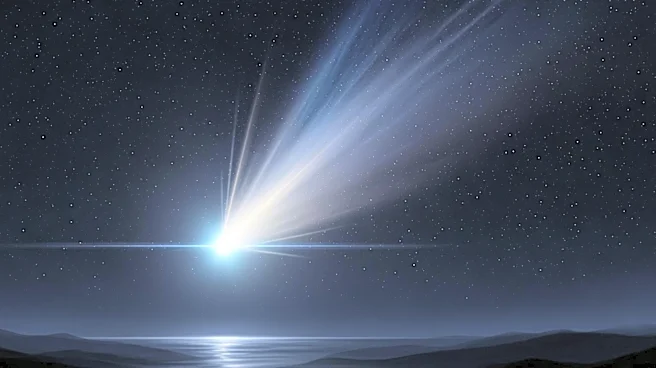
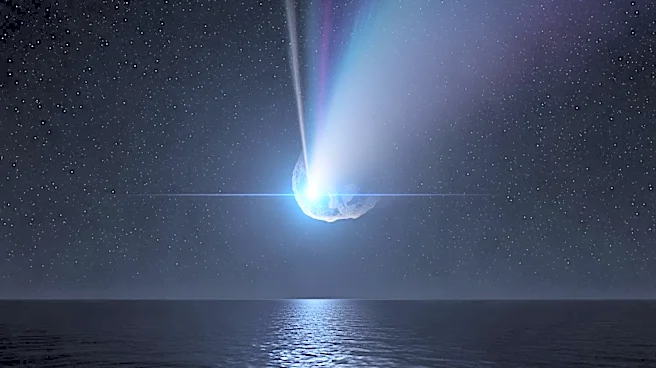
Comet C/2025 R3, discovered by Pan-STARRS in September 2025, is set to make a significant appearance in the Northern Hemisphere's sky this month. The comet, a cosmic snowball composed of frozen gases,
rock, and dust, will reach its closest point to the Sun, known as perihelion, on April 19-20, and its closest point to Earth, known as perigee, on April 25-27. During this time, it may become visible to the naked eye, although its brightness remains uncertain. The comet's proximity to the Sun and Earth could result in it brightening and developing glowing tails of gas and dust, or it might disintegrate entirely. For optimal viewing, observers are advised to use binoculars or telescopes and find a dark area away from street lights.
Why It's Important?
The appearance of Comet C/2025 R3 presents a rare opportunity for both amateur and professional astronomers to observe a celestial event that could provide insights into the composition and behavior of comets. Such events can enhance our understanding of the solar system's dynamics and the processes that govern cometary activity. Additionally, the potential visibility of the comet to the naked eye could spark public interest in astronomy and space science, encouraging educational and outreach activities. The event also underscores the importance of ongoing astronomical surveys and the role of observatories like Pan-STARRS in discovering and tracking celestial objects.
What's Next?
As Comet C/2025 R3 approaches its closest points to the Sun and Earth, astronomers will continue to monitor its brightness and behavior. Observations will be crucial in determining whether the comet will develop visible tails or disintegrate. The data collected during this period will contribute to models of cometary dynamics and may inform future missions aimed at studying comets up close. Public interest in the event could lead to increased participation in stargazing events and educational programs, fostering a greater appreciation for astronomy.