



What's Happening?
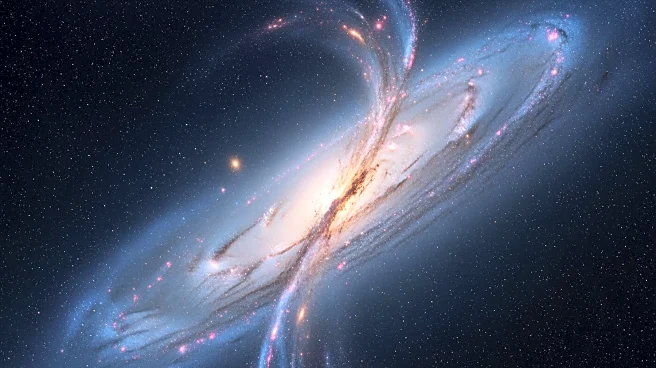
Astronomers have identified the largest known spinning structure within the cosmic web, a filament approximately 117,000 light-years across and 5.5 million light-years long, located 424 million light-years away. This discovery was made using data from
South Africa’s MeerKAT radio telescope, along with observations from the Dark Energy Spectroscopic Instrument (DESI) and Sloan Digital Sky Survey (SDSS). The filament contains 14 galaxies that exhibit synchronized rotation, with their spin directions aligning with the filament's twist. This alignment suggests a transfer of angular momentum from the large-scale structure to the galaxies, providing critical insights into galaxy formation and the acquisition of angular momentum. The galaxies are rich in neutral hydrogen, which acts as a tracer for gas and momentum flow, offering a live demonstration of how galaxies gather the material and spin needed for growth.
Why It's Important?
This discovery is significant as it enhances the understanding of galaxy formation and evolution within their cosmic environment. The alignment of galaxies within the filament challenges the assumption that galaxy spin directions are random, suggesting a gravitational interaction that transfers angular momentum from the filament to the galaxies. This has implications for refining weak lensing observations, which are used to study dark matter distribution and cosmic expansion. The presence of such structures could contaminate weak lensing data, making it crucial to account for these alignments in cosmological studies. Understanding these structures also positions filaments as important cosmological probes, as they are predicted to contain a significant portion of the universe's mass.
What's Next?
Future research aims to identify more spinning structures using new data from radio telescopes like MeerKAT and optical telescopes such as Vera Rubin and Euclid. These efforts will help describe these structures more accurately as a population, improving the precision of weak lensing measurements. By understanding the alignments within filaments, astronomers can better predict and account for their effects on lensing data. This research will also contribute to a more comprehensive exploration of the cosmic web, enhancing the understanding of the universe's large-scale structure and the role of filaments in galaxy formation.
Beyond the Headlines
The discovery of this spinning structure highlights the complex interactions within the cosmic web and the role of gravitational forces in shaping galaxy dynamics. The study of these alignments offers a unique opportunity to test and refine cosmological models, particularly in understanding the distribution of dark matter and the universe's accelerated expansion. As more data becomes available, the study of filaments could reveal new insights into the fundamental processes governing the universe's evolution, potentially leading to breakthroughs in cosmology and astrophysics.