
What's Happening?
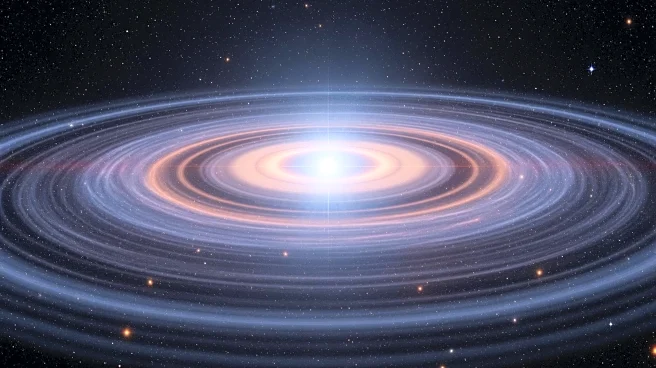
NASA's Hubble Space Telescope has captured images of the largest protoplanetary disk ever observed, circling a young star cataloged as IRAS 23077+6707. This disk, nicknamed 'Dracula's Chivito,' spans nearly
400 billion miles, which is 40 times the diameter of our solar system. The disk is unusually chaotic, with bright wisps of material extending far above and below it, a feature not seen in similar systems. The disk's peculiar, lopsided structure suggests dynamic processes, such as the infall of dust and gas, are shaping it. This discovery provides new insights into planet formation in extreme environments.
Why It's Important?
The findings from Hubble's observations mark a significant milestone in understanding planet formation. The chaotic nature of the disk around IRAS 23077+6707 offers a unique perspective on how planets may form in environments vastly different from our solar system. This could lead to a better understanding of the diversity of planetary systems in the galaxy. The disk's mass, estimated to be 10 to 30 times that of Jupiter, suggests the potential for forming multiple gas giants, making it an exceptional case for studying the birth of planetary systems.
What's Next?
The new images from Hubble provide a starting point for further research into the processes of planet formation. Scientists will likely continue to study this system to understand the underlying mechanisms that lead to planet formation in such massive environments. Future observations, possibly with the James Webb Space Telescope, could provide even more detailed insights into the substructures of the disk and the potential for planet formation.