





What's Happening?
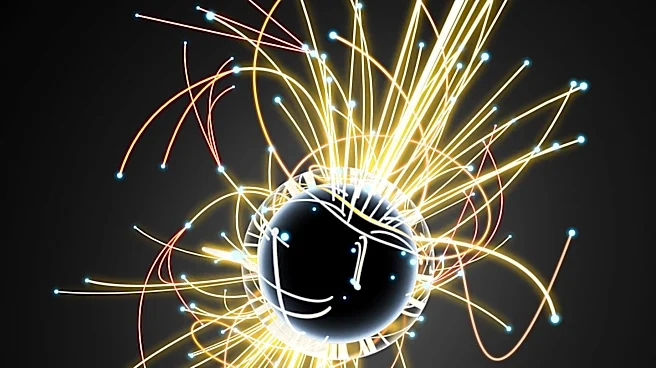
Physicists at the European Organization for Nuclear Research (CERN) have captured evidence of an extremely rare particle decay, specifically the decay of a 'Bd meson' into a 'muon' and an 'anti-muon'. This event is predicted to occur only once in 10 billion
instances. The international Large Hadron Collider beauty (LHCb) collaboration announced this finding on November 3rd, with the research paper submitted to the international journal 'Physical Review X' after being posted on the preprint server 'arXiv' on October 30th. While this observation does not indicate new physics, it aligns with the predictions of the Standard Model of particle physics. The LHCb collaboration utilized data collected in 2024–2025, following an upgrade in 2022 that significantly increased the detector's data collection capacity. Machine learning was employed to analyze vast amounts of proton collision data to identify these rare decay candidates. The statistical significance of the Bd meson decay evidence is 3 sigma, increasing to 3.2 sigma when combined with data from 2011–2018. The measured decay probabilities for both Bd and Bs mesons are consistent with Standard Model predictions.
Why It's Important?
This achievement is crucial for fundamental physics as it provides an important benchmark for future experiments and theoretical explorations within the existing particle physics framework, the Standard Model. The Standard Model describes the fundamental particles and forces that constitute matter, and while it has been highly successful, it doesn't explain phenomena like dark matter, dark energy, or matter-antimatter asymmetry. The LHCb collaboration's primary goal is to search for new laws of physics beyond the Standard Model by precisely observing particle changes, particularly the decay of B mesons. Discrepancies between predicted and measured decay probabilities or lifetimes of B mesons could hint at undiscovered particles or interactions. The confirmation of this ultra-rare decay, even if consistent with the Standard Model, expands the experimental foundation necessary to test for the existence of new particles. This high-precision measurement demonstrates the capabilities of current experimental techniques and sets the stage for more sensitive searches for new physics in the future.
What's Next?
CERN plans to significantly enhance its data collection capabilities further. The High-Luminosity Large Hadron Collider (HL-LHC) is expected to be operational around 2030, aiming to increase data collection rates by approximately tenfold. Additionally, further upgrades to the LHCb detector are scheduled for the mid-2030s. These advancements will enable physicists to test rare particle decay processes with much higher precision. The increased data and improved detector sensitivity will be critical in the ongoing search for physics beyond the Standard Model, potentially revealing clues about the nature of dark matter, dark energy, and other unresolved mysteries in the universe. Researchers will continue to scrutinize these rare decays for any subtle deviations from theoretical predictions, which could signal the presence of new fundamental particles or forces.
Beyond the Headlines
The meticulous effort to observe such an infrequent event underscores the scientific community's dedication to pushing the boundaries of human knowledge. The use of advanced machine learning techniques to sift through immense datasets highlights the growing synergy between cutting-edge physics research and artificial intelligence. While the current findings reinforce the Standard Model, the continuous pursuit of higher precision and the search for anomalies are central to scientific progress. The ability to confirm such rare decays provides confidence in the experimental methods and theoretical models, but also serves as a foundation for identifying the subtle deviations that could lead to revolutionary discoveries. This ongoing work at CERN represents a long-term investment in understanding the fundamental building blocks of the universe and the forces that govern them, with potential implications for our understanding of cosmic evolution and the very nature of reality.