






What's Happening?
The U.S. Supreme Court is once again reviewing a congressional map for Missouri, marking the third time this map, supported by President Trump, has come before the court. This latest appeal follows an unusual ruling by a federal appeals court that ordered
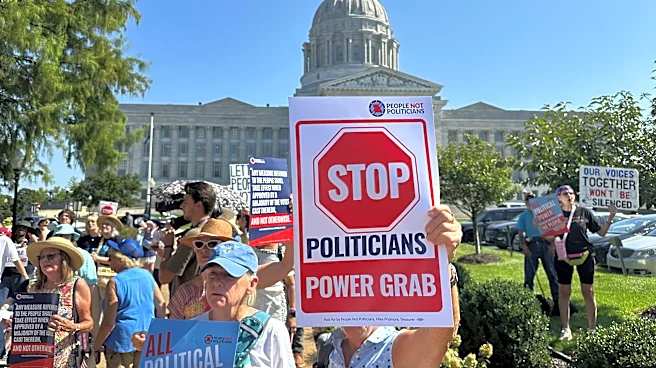
the reinstatement of the GOP-friendly map. The new map was designed to potentially secure an additional U.S. House seat for Republicans in the upcoming midterm elections, which will determine control of Congress. Previously, the Supreme Court had twice blocked the implementation of this map. The Missouri Supreme Court had ruled that the new districts could not take effect without voter approval through a statewide referendum. The Supreme Court has given proponents of the new map until midday Wednesday to submit their response to the latest appeal. This ongoing dispute has created significant confusion for over a million potential voters in Missouri, as absentee voting is already underway using the districts adopted in 2022.
Why It's Important?
This recurring legal battle over Missouri's congressional map carries significant implications for the balance of power in the U.S. House of Representatives. The map, if implemented, could help Republicans gain a crucial seat, potentially shifting the control of Congress. The involvement of President Trump in advocating for this specific map underscores the high stakes involved in redistricting efforts, particularly in a politically charged environment leading up to midterm elections. The confusion among over a million voters due to the shifting district lines highlights a broader challenge to democratic processes and voter confidence. The Supreme Court's repeated engagement with this issue also emphasizes the judiciary's critical role in overseeing electoral fairness and the constitutional integrity of redistricting. The outcome will not only affect Missouri's representation but could also set precedents for how states approach redistricting in the future, especially concerning mid-decade changes.
What's Next?
The immediate next step is the deadline for supporters of the Trump-backed map to respond to the latest appeal by midday Wednesday. Following this, the U.S. Supreme Court will decide whether to allow the new map to proceed or to uphold its previous decisions, which favored the use of the 2022 districts. The ongoing legal uncertainty means that Missouri voters may continue to face confusion regarding their congressional districts, especially as absentee voting is already in progress. Depending on the Supreme Court's ruling, there could be further legal challenges or a definitive resolution that either solidifies the current district lines or implements the new, GOP-friendly map. The decision will undoubtedly influence the strategies of both Republican and Democratic parties in the lead-up to the midterm elections, as the control of Congress hangs in the balance.
Beyond the Headlines
The protracted legal struggle over Missouri's congressional map reveals deeper tensions within the American political system regarding partisan gerrymandering and the integrity of electoral processes. The attempt to redraw districts mid-decade, spurred by President Trump's encouragement, highlights a growing trend where political parties seek to maximize their electoral advantage through legislative means rather than solely through voter persuasion. This situation raises fundamental questions about the fairness of representation and the potential for political maneuvering to undermine the democratic principle of 'one person, one vote.' The Supreme Court's role in adjudicating these disputes underscores the judiciary's position as a critical check on legislative power, particularly when electoral boundaries are contested. The outcome of this case could have long-term implications for how states conduct redistricting, potentially influencing future legislative efforts to reshape electoral maps for partisan gain across the nation.