
What's Happening?
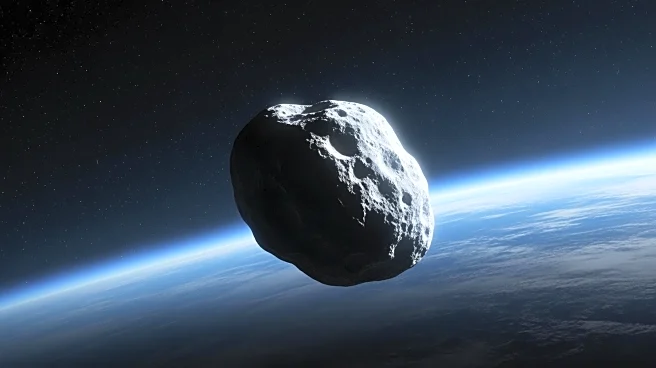
NASA is closely monitoring an asteroid, designated as 2025 XN4, which is approaching Earth at a speed of over 33,000 miles per hour. According to NASA's Center for Near Earth Object Studies (CNEOS), the
asteroid is expected to make its closest approach to Earth on Tuesday, coming within approximately 123,000 miles of the planet. Despite its proximity, NASA has determined that 2025 XN4 poses no significant impact risk to Earth. The asteroid is about 38 feet in diameter, roughly the size of a bus. In addition to 2025 XN4, NASA is also tracking several other asteroids, including 2025 XX2, which is expected to pass by Earth at a distance of 580,000 miles. These observations are part of NASA's ongoing efforts to monitor near-Earth objects that could potentially pose a threat to the planet.
Why It's Important?
The monitoring of asteroids like 2025 XN4 is crucial for planetary defense and understanding the potential risks posed by near-Earth objects. While 2025 XN4 does not pose an immediate threat, the tracking and study of such objects help scientists develop strategies to mitigate potential future impacts. This is particularly important as some asteroids, classified as potentially hazardous asteroids (PHAs), have orbits that could bring them closer to Earth over time. By studying these objects, NASA can better predict their trajectories and assess any long-term risks they may pose. The information gathered also contributes to the broader scientific understanding of the solar system and the formation of celestial bodies.
What's Next?
NASA will continue to monitor 2025 XN4 and other near-Earth objects as part of its planetary defense strategy. The agency's efforts include refining the orbits of these objects to improve predictions of their future paths. Additionally, NASA is working on developing technologies and strategies to deflect or disrupt asteroids that may pose a significant threat to Earth in the future. Public awareness and education about the potential risks and the measures in place to address them are also likely to be part of NASA's ongoing efforts. As technology advances, the ability to detect and respond to potential asteroid threats will continue to improve, enhancing global preparedness for any future scenarios.