








What's Happening?
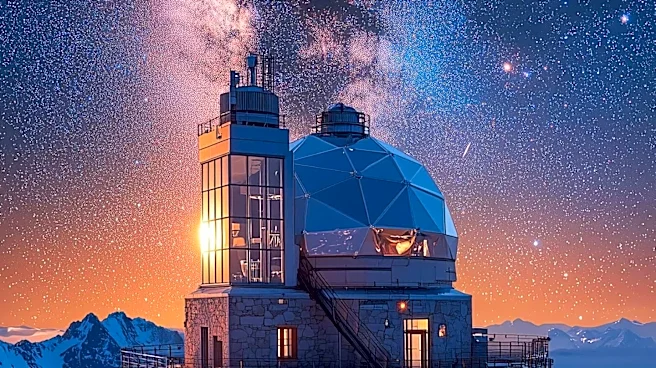
The Vera C. Rubin Observatory has commenced its 10-year Legacy Survey of Space and Time (LSST), marking a new era in astronomy. This ambitious project involves using a 3200-megapixel camera, the largest digital camera ever created, to scan the entire
sky over the southern hemisphere every few nights. The survey aims to create an ultra-wide, ultra-high-definition time-lapse record of the cosmos, covering each point in the sky 800 times over the decade. The LSST will explore the mysteries of dark energy and dark matter, as well as discover millions of new asteroids and comets within our solar system.
Why It's Important?
The LSST represents a significant leap forward in our ability to observe and understand the universe. By capturing detailed images of the cosmos, the Rubin Observatory will provide invaluable data that could lead to breakthroughs in cosmology and astrophysics. The project is expected to enhance our understanding of dark energy and dark matter, which are fundamental to the structure and expansion of the universe. Additionally, the discovery of new celestial bodies within our solar system will contribute to our knowledge of its formation and evolution. This initiative underscores America's leadership in scientific innovation and its commitment to expanding the frontiers of knowledge.
What's Next?
As the LSST progresses, the Rubin Observatory will continue to collect and analyze data, with results being made available to scientists and the public. This open-access approach will foster collaboration and innovation across the global scientific community. The findings from the survey are anticipated to influence future research directions and inspire new theories about the universe. The observatory's work will also support educational initiatives, engaging the public in the wonders of space exploration and encouraging the next generation of astronomers.