





What's Happening?
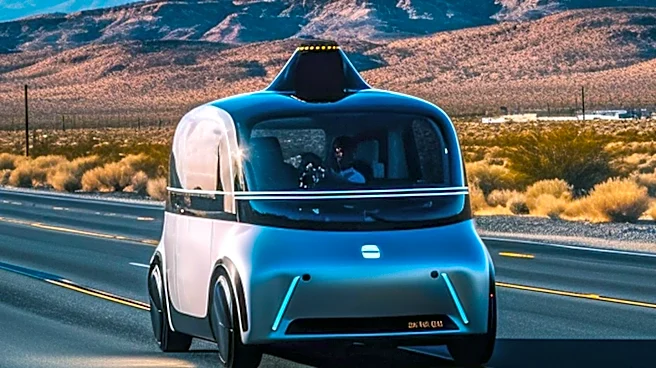
The autonomous driving industry, despite significant investment exceeding $100 billion, has faced considerable setbacks and has yet to achieve widespread adoption of fully autonomous vehicles. While robotaxi services from companies like Google-owned Waymo,
Amazon’s Zoox, and Tesla operate in limited U.S. cities, and Uber in Abu Dhabi, these remain geographically restricted. Major projects, such as Apple’s Project Titan and Uber’s autonomous taxi venture, have been shut down due to technological immaturity or safety concerns. General Motors’ Cruise also halted operations after a serious accident. Experts attribute these failures to companies rushing to market before the technology was ready and the immense challenge of developing systems that can reliably handle rare physical events in real-world driving conditions. The industry is now focusing on advanced sensor technologies like lidar and high-definition radar, and the development of 'Physical AI' models that understand real-world physics.
Why It's Important?
The slow progress and past failures in the autonomous vehicle sector have significant implications for U.S. industries, particularly automotive manufacturing, technology, and transportation. The substantial investments made by U.S. companies like Google, Amazon, and Tesla highlight the strategic importance placed on this technology for future economic growth and global competitiveness. However, the challenges in achieving full autonomy mean that the promised benefits of increased safety, efficiency, and accessibility in transportation are delayed. This impacts urban planning, infrastructure development, and the potential for new business models in logistics and personal mobility. The need for robust sensor technology and advanced AI development also creates opportunities for specialized tech companies, while the high cost of development and regulatory hurdles continue to be significant barriers to entry and expansion for many. The public's low tolerance for errors in autonomous systems further complicates market acceptance and regulatory approval.
What's Next?
The autonomous vehicle industry is expected to continue its evolution, moving towards more standardized computing platforms and sensor combinations. In the near term, consumers in the U.S. are likely to see an expansion of robotaxi services in limited areas and potentially a growth in autonomous trucking fleets. Fully autonomous private cars are anticipated to require further advancements in AI, additional proof of safety, and a reduction in hardware costs, with some experts estimating private ownership in the West around 2030. The focus will be on developing 'Physical AI' models that can understand complex real-world physics and utilizing simulations to train systems for extreme scenarios. Companies like NVIDIA are developing in-vehicle computing platforms to process multi-sensor information in real-time. The integration of lidar and high-definition radar will also be crucial for enhancing perception capabilities, especially in adverse weather conditions. The defense sector is also emerging as a significant market for these sensor technologies, particularly for autonomous combat vehicles and drone detection systems.
Beyond the Headlines
The long-term implications of autonomous vehicles extend far beyond the automotive industry, potentially reshaping urban landscapes and societal norms. If driving no longer requires a human driver, demand for personal road travel could increase, challenging existing transportation planning aimed at promoting public transit. This could lead to increased traffic congestion and a need for significant infrastructure overhauls. Furthermore, autonomous vehicles could provide mobility to demographics currently unable to drive, such as children, the elderly, and individuals with disabilities, thereby increasing their independence and access to services. The ethical dimensions of AI decision-making in accident scenarios, the legal framework for liability, and the potential for job displacement in the transportation sector are also critical considerations. The development of 'world models' that understand causality and physics represents a profound shift in AI capabilities, with potential applications across various robotics and automation fields, signaling a broader 'Physical AI' revolution.