

What's Happening?
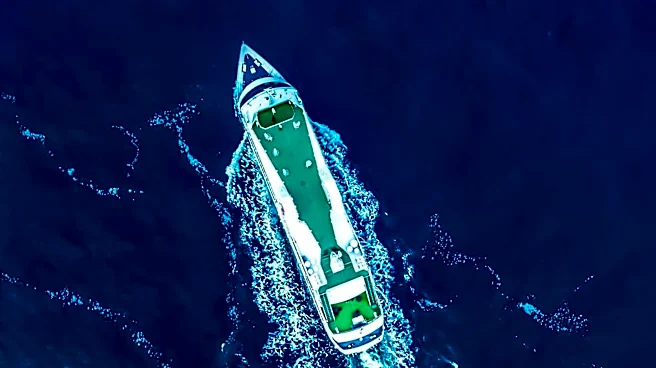
ASENAV, a Chilean shipbuilding company, has signed a contract to build a hybrid research vessel for the University of California, San Diego. This 38-meter vessel will replace the aging Research Vessel Robert Gordon Sproul and will be part of the U.S.
Academic Research Fleet. Designed by Glosten, a U.S.-based naval architecture firm, the vessel will support scientific missions in various fields such as biology, chemistry, and oceanography. It will be capable of operating over 200 days a year, carrying up to 20 crew members and scientists, and accommodating 40 students for educational deployments. The vessel will feature advanced acoustic systems for seafloor mapping and dynamic positioning capabilities for precise operations.
Why It's Important?
The construction of this hybrid research vessel represents a significant advancement in marine research capabilities for UC San Diego and the broader scientific community. By incorporating hybrid propulsion and low-emission technologies, the vessel aligns with environmental sustainability goals while enhancing research efficiency. It will enable scientists to conduct extensive studies along the Eastern Pacific coast, contributing to a deeper understanding of marine ecosystems and environmental changes. The vessel's integration into the U.S. Academic Research Fleet underscores the importance of collaborative efforts in advancing oceanographic research and education.
What's Next?
The project is expected to be completed within 24 months, with the vessel ready for deployment by July 2028. Once operational, it will facilitate numerous scientific missions, supporting up to 55 missions annually. The vessel's capabilities will allow researchers to explore new areas of study and gather critical data on oceanic and environmental phenomena. As the vessel becomes a key asset in the U.S. Academic Research Fleet, it will likely foster partnerships and collaborations with other research institutions, enhancing the collective knowledge and understanding of ocean sciences.