





What's Happening?
House Majority Whip Tom Emmer has voiced strong criticism regarding the Senate's failure to act on several key pieces of legislation passed by the House, including the SAVE America Act, the Clarity Act, and Reconciliation 3.0. During an appearance on 'Sunday
Morning Futures' with guest host Cheryl Casone, Emmer expressed frustration that the Senate has not advanced measures he claims have broad public support. Specifically, he highlighted the SAVE America Act, which proposes voter ID requirements and mandates that voters establish lawful citizenship, stating that it is an '80 percent issue across this country.' Emmer also noted the House's priority to pass a short-term government funding bill to prevent a pre-election shutdown, emphasizing the House's efforts to 'get things done' by sending these priorities to the Senate. He pointed out that the Clarity Act, a market structure bill concerning digital assets, was sent to the Senate a year ago with nearly a hundred Democrat votes and remains unaddressed.
Why It's Important?
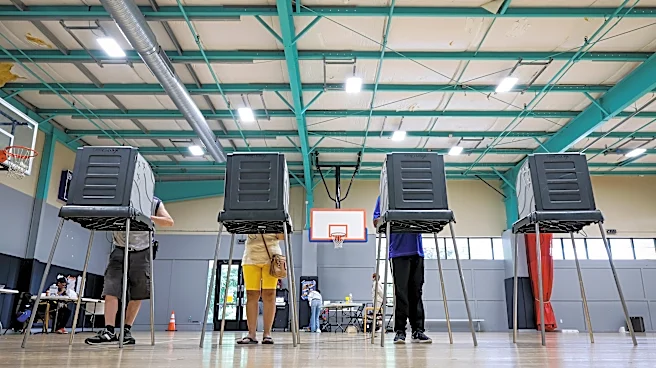
The ongoing legislative gridlock between the House and Senate, as highlighted by Majority Whip Emmer, has significant implications for U.S. governance and public policy. The stalled SAVE America Act touches upon the contentious issue of election integrity, a topic that has been central to recent political discourse and could influence voter confidence and participation in upcoming elections. The proposed voter ID requirements, if enacted, would represent a substantial shift in election procedures across the nation. Furthermore, the delay in passing the Clarity Act, which addresses digital assets, could hinder the development and regulation of the burgeoning cryptocurrency and blockchain industries in the U.S., potentially impacting innovation and economic competitiveness. The broader inability to pass legislation, including critical funding bills, raises concerns about governmental efficiency and the potential for disruptions like government shutdowns, which can have widespread economic and social consequences.
What's Next?
With only 16 legislative days remaining before October 1st, the immediate focus for the House, as stated by Majority Whip Emmer, will be to pass the short-term government funding bill to avert a pre-election shutdown. Emmer indicated that the House will continue to address appropriations bills and other priorities, but he placed the onus on the Senate to 'start to perform' and act on the legislation already sent over. The future of the SAVE America Act and the Clarity Act remains uncertain, as Emmer noted that it is 'still unclear if Senator Majority Leader John Thune has the votes for SAVE America.' The coming weeks will likely see continued political maneuvering and debate as both chambers of Congress attempt to navigate their legislative agendas ahead of the next election cycle, with the potential for further public pressure on the Senate to address the stalled bills.
Beyond the Headlines
The legislative stalemate described by Majority Whip Emmer underscores a deeper challenge within the U.S. political system: the increasing difficulty of achieving bipartisan consensus on key issues. The SAVE America Act, with its focus on voter identification and citizenship verification, reflects a broader ideological divide concerning voting rights and election security. The claim that such measures are supported by '80 percent of Americans' suggests a perceived disconnect between public opinion and legislative action, which could further erode public trust in governmental institutions. The languishing of the Clarity Act, despite bipartisan support in the House, highlights the complexities of legislating in rapidly evolving sectors like digital assets, where regulatory clarity is crucial for market stability and growth. This ongoing friction between the House and Senate, particularly on issues with significant public interest, could exacerbate political polarization and impact the effectiveness of future legislative efforts.