




What's Happening?
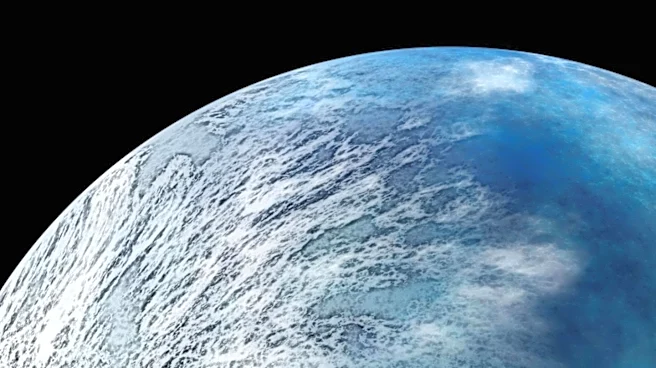
Scientists who reported evidence of water plumes erupting from Jupiter's moon Europa in 2014 have re-analyzed 14 years of Hubble Space Telescope data, significantly reducing their confidence in the original findings. The initial 2014 study, published
in Science, indicated a 99.9% confidence level in localized ultraviolet emissions near Europa's south pole, interpreted as water vapor. However, a new paper, led by Lorenz Roth and including many of the original researchers, now finds no statistically persuasive localized water-vapor emission in any suitable Hubble images, including the one that formed the basis of the 2014 claim. The confidence level has dropped to below 90%. This re-evaluation stems from methodological changes in data analysis, specifically regarding the assumed position of Europa's disk on Hubble's detector and a more comprehensive model of Europa's extended atomic-hydrogen exosphere. The original data itself has not changed, but the interpretation of what produced the light has been revised, suggesting the initial signal may have been statistical noise.
Why It's Important?
This re-evaluation is significant for planetary science and future space missions, particularly NASA's Europa Clipper. The potential for water plumes on Europa has been a major driver for mission planning, as such plumes could offer a way to sample Europa's subsurface ocean without needing to drill through kilometers of ice. If the plumes are not definitively present or are less frequent than previously thought, it complicates the strategy for directly analyzing the ocean's composition and assessing its potential for habitability. While Europa is still believed to harbor a global salty ocean based on other evidence (magnetic induction, surface geology, gravity, and tidal behavior), the direct accessibility of that ocean via plumes is now less certain. This shift impacts the scientific community's understanding of Europa's active geology and the methods by which its internal environment might interact with space.
What's Next?
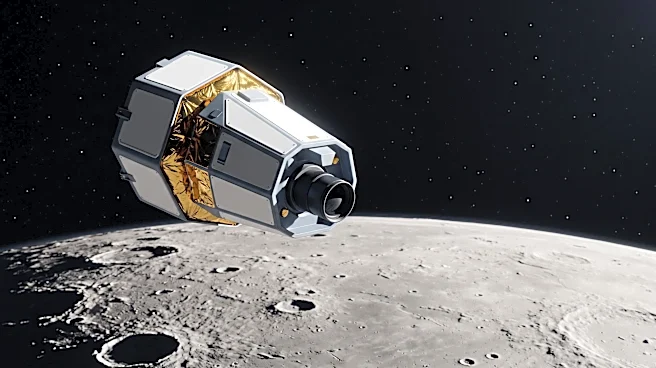
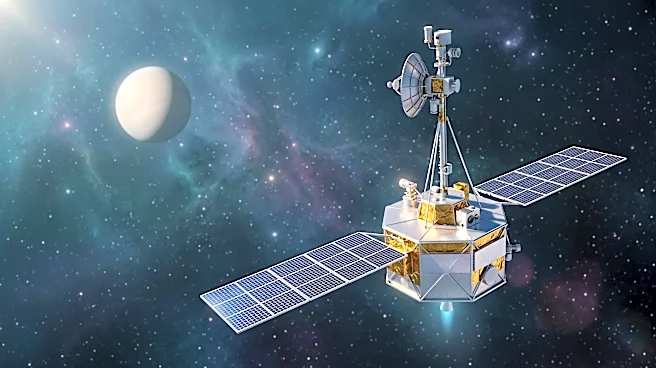
The scientific community will continue to search for evidence of plumes on Europa. NASA's Europa Clipper mission, scheduled to reach Jupiter in April 2030, is equipped with instruments specifically designed to investigate this question. Its cameras will look for jets, the Europa Ultraviolet Spectrograph will search for gas, and MASPEX and SUDA will identify molecules and particles encountered around the moon. While a flyby through fresh ejecta would be highly valuable, the mission's success does not solely depend on detecting a plume. Radar, magnetometry, gravity, thermal imaging, and surface spectroscopy will still investigate the ice and ocean. ESA's JUICE spacecraft will also conduct Europa flybys. These missions will provide much closer and more detailed observations, potentially placing stronger limits on the frequency, size, and location of any intermittent eruptions, even if they don't conclusively prove their constant presence.
Beyond the Headlines
This development highlights the rigorous and iterative nature of scientific inquiry. The original team's willingness to re-examine their own celebrated findings with new data and improved models demonstrates a commitment to scientific accuracy, even when it means weakening a previous conclusion. It underscores that initial findings, especially at the limits of observational capabilities, are often subject to refinement as more data becomes available and analytical techniques evolve. The distinction between raw data and its interpretation is crucial; while the pixels from Hubble remain the same, the understanding of what they represent can change. This process strengthens the overall scientific understanding of celestial bodies like Europa, ensuring that conclusions are based on the most robust evidence and analysis available, rather than prematurely accepted inferences.