
What's Happening?
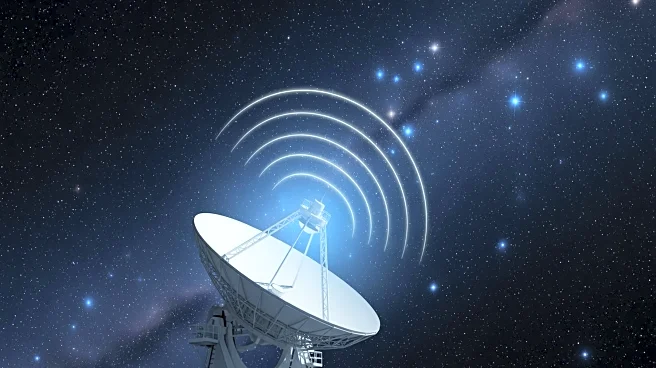
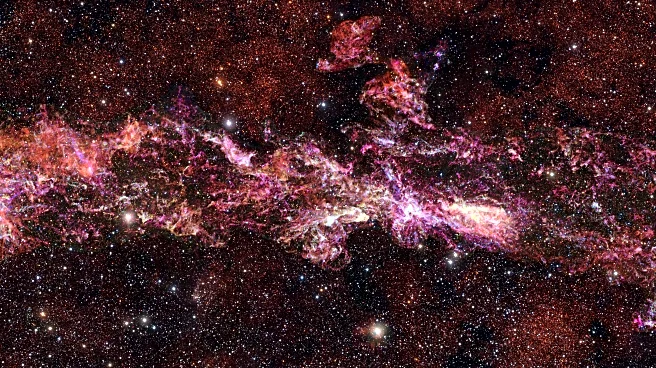
Astronomers have unveiled a detailed image of the Milky Way's central region, showcasing a complex network of cosmic gas filaments. This image, captured by the Atacama Large Millimeter/submillimeter Array (ALMA), is the largest of its kind and provides
unprecedented insight into the Central Molecular Zone (CMZ) of our galaxy. The CMZ is a region rich in cold molecular gas, the raw material for star formation, and is located near the supermassive black hole at the galaxy's center. The survey, known as the ALMA CMZ Exploration Survey (ACES), has revealed intricate details of the gas structures, ranging from large formations to small clouds around individual stars. This dataset is crucial for understanding star formation in extreme environments, similar to those in early galaxies.
Why It's Important?
The findings from this survey are significant for astrophysics as they offer a deeper understanding of star formation processes in extreme conditions. The CMZ hosts some of the most massive stars in the galaxy, which often end their lives in supernovae or hypernovae. By studying this region, astronomers can gain insights into the life cycles of stars and the evolution of galaxies. The data also help refine theories of star formation and provide a comparative framework for studying distant galaxies. This research could lead to advancements in our understanding of the universe's history and the forces shaping it.
What's Next?
Future research will build on these findings, with plans to use the upcoming ALMA Wideband Sensitivity Upgrade and the Extremely Large Telescope to explore the CMZ in even greater detail. These tools will allow astronomers to resolve finer structures, trace more complex chemistry, and study the interactions between stars, gas, and black holes with unprecedented clarity. This ongoing research will continue to enhance our understanding of the Milky Way and other galaxies, potentially leading to new discoveries about the universe's formation and evolution.