



What's Happening?
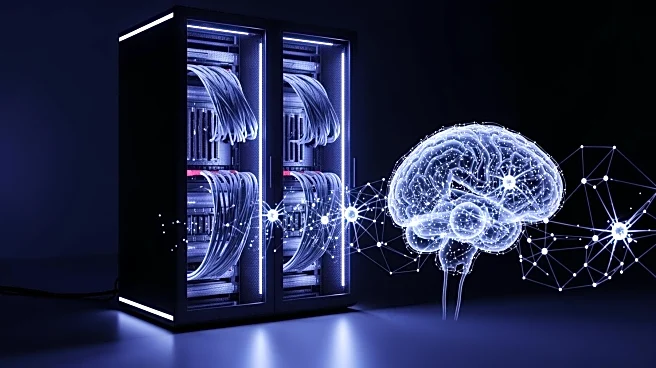
Researchers at the Jülich Research Centre in Germany are embarking on an ambitious project to simulate the human brain using the JUPITER supercomputer. Led by neurophysics professor Markus Diesmann, the team plans to integrate several models of smaller
brain regions to simulate billions of firing neurons. JUPITER, ranked as the fourth most powerful supercomputer globally, will be instrumental in this endeavor. The project builds on previous efforts like the Human Brain Project, which did not achieve its goals despite significant funding. The researchers have already demonstrated that a 'spiking neural network' can be scaled to match the cerebral cortex's 20 billion neurons and 100 trillion connections. This simulation aims to provide a deeper understanding of brain functions, although it acknowledges the complexity and mystery that still surrounds the human brain.
Why It's Important?
This project represents a significant leap in computational neuroscience, potentially transforming our understanding of the human brain. By simulating the brain at such a large scale, researchers hope to uncover new insights into how neural networks operate, which could have profound implications for neuroscience, medicine, and artificial intelligence. The ability to simulate complex brain functions could lead to breakthroughs in treating neurological disorders and advancing AI technologies. However, the project also highlights the challenges of replicating the intricacies of the human brain, emphasizing the limitations of current technology in fully understanding brain functions.
What's Next?
The next steps involve further scaling the neural network simulations and refining the models to more accurately represent human brain functions. Researchers will continue to leverage JUPITER's capabilities to enhance the simulation's complexity and accuracy. The scientific community will be closely monitoring the project's progress, as its outcomes could influence future research directions in neuroscience and AI. Potential collaborations with other research institutions and technology companies may also emerge as the project advances.
Beyond the Headlines
The ethical implications of simulating the human brain are significant, raising questions about the potential for creating conscious entities or replicating human thought processes. The project also underscores the growing intersection of technology and biology, prompting discussions about the role of supercomputers in understanding and potentially altering human cognition. As the simulation progresses, it may also contribute to debates on the limits of artificial intelligence and the ethical boundaries of scientific exploration.