



What's Happening?
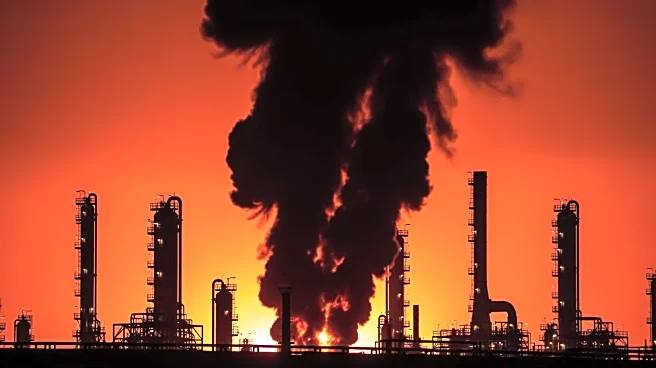
Recent satellite imagery and verified videos have revealed that Ukraine has conducted strikes on key Russian oil export infrastructure near the Baltic Sea, resulting in significant fires at several facilities. The attacks targeted oil sites in Russia's
Leningrad region, including the Baltic Sea ports of Ust-Luga and Primorsk, as well as the Kirishi oil refinery. These strikes have disrupted oil exports, with no ships loaded at Russia's Baltic ports for two consecutive days, a first since the start of the Ukraine conflict in 2022. The Centre for Research on Energy and Clean Air (Crea) reported that these ports accounted for a substantial portion of Russia's oil exports in 2025.
Why It's Important?
The strikes on Russian oil facilities highlight the ongoing conflict between Ukraine and Russia, with significant implications for global oil markets. The disruption of oil exports from Russia, a major global supplier, could lead to increased volatility in oil prices, affecting economies worldwide. The attacks underscore Ukraine's strategic targeting of Russian infrastructure to weaken its economic capabilities. This development may prompt international responses, including potential diplomatic efforts to de-escalate the conflict and stabilize oil markets. The situation also reflects the broader geopolitical tensions in the region, with potential impacts on energy security and international relations.
What's Next?
The continuation of such strikes could lead to further disruptions in global oil supply, prompting responses from major oil-importing countries. The international community may seek to mediate between Ukraine and Russia to prevent further escalation. Additionally, there may be increased efforts to secure alternative energy sources and routes to mitigate the impact of disrupted Russian oil exports. The situation could also influence future military and strategic decisions by both Ukraine and Russia, as well as their respective allies.