





What's Happening?
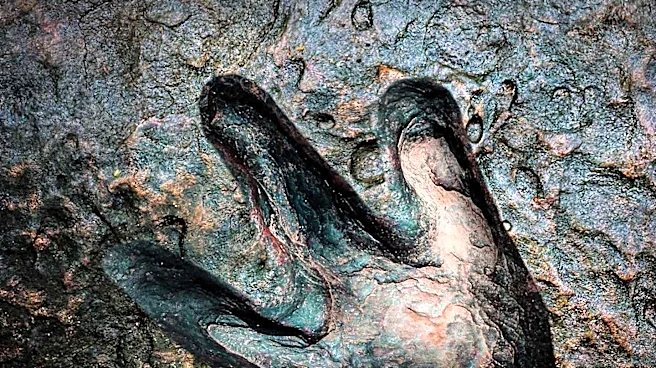
Researchers have uncovered at least 50 fossilized dinosaur footprints in western Mexico, estimated to be approximately 65 million years old. The discovery, announced by Mexico’s National Institute of Anthropology and History (INAH), was made in a streambed
near San Juan de los Plátanos, Michoacán, after residents reported unusual impressions. Paleontologist Raymundo Cervantes Barriga confirmed the tracks were left by dinosaurs. The footprints, ranging from 12 to 48 centimeters in length, suggest the presence of at least three different dinosaur families: large carnivorous theropods possibly from the tyrannosaurid family, smaller raptor-like dromaeosaurids, and plant-eating hadrosaurs. The site spans about 40 square meters of exposed sedimentary rock, with many more tracks potentially hidden. This discovery marks the fourth known dinosaur footprint site in Michoacán and adds to over 30 such sites recorded across Mexico.
Why It's Important?
This discovery is significant as it opens a rare window into prehistoric life during the Late Cretaceous period in Mexico. The variety of footprints provides crucial evidence about the types of dinosaurs that inhabited the region, including large meat-eating predators, raptor-like species, and plant-eaters. Analyzing these tracks can reveal insights into dinosaur behavior, such as how they walked and how different species utilized the same landscape. Similar research in Canada has shown that such fossil evidence can even suggest herd behavior among different dinosaur species. For paleontologists and researchers, this site offers a unique opportunity to study a period that is often conceptualized but rarely directly observed through such extensive fossil records. The potential for more discoveries in unexplored sections of the site further enhances its importance for understanding ancient ecosystems.
What's Next?
INAH specialists have initiated comprehensive documentation of the site, which includes creating 3D models of the footprints, making molds of the impressions, and analyzing rock samples. This detailed work aims to preserve the findings and extract maximum scientific information. Researchers will continue to investigate the site, with the expectation that additional footprints may emerge as investigations progress, given that large sections remain unexplored. The next steps will involve further analysis to determine the exact species responsible for the tracks and to reconstruct the ancient environment and ecological interactions of the dinosaurs. This ongoing research will contribute to a broader understanding of dinosaur distribution and behavior in North America during the Late Cretaceous period.
Beyond the Headlines
The discovery of these dinosaur footprints extends beyond mere scientific curiosity, offering a tangible connection to Earth's deep past. It highlights the role of local communities in scientific discovery, as residents initially reported the unusual impressions. Such findings often spark public interest in paleontology and natural history, potentially inspiring future generations of scientists. Ethically, the preservation and study of these sites underscore the importance of protecting natural heritage and archaeological resources. Culturally, these discoveries contribute to a global narrative of life on Earth, reminding us of the vast timescales of evolution and the dynamic nature of our planet's ecosystems. The ongoing work at this site could also lead to new methodologies for studying ancient trackways and understanding the locomotion and social structures of extinct species.