





What's Happening?
An Indian space startup, Akashalabdhi Space, has successfully tested an experimental inflatable structure at an altitude of approximately 30 km. This test, conducted via a high-altitude balloon launched from the Tata Institute of Fundamental Research's
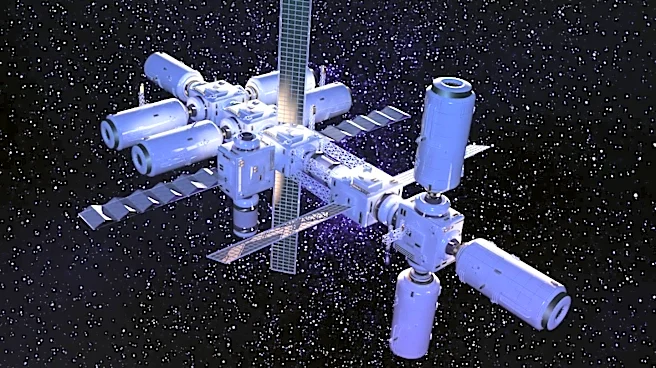
National Balloon Facility in Hyderabad, is a significant step towards developing expandable space habitats and orbital factories. The 25-kg experimental mission, part of the company's ANTARIKSHAB program, aimed to evaluate the structure's deployment, inflation, rigidization, autonomous control systems, avionics, electrical power systems, and telemetry. Unlike traditional spacecraft, rigidisable inflatable systems can be compactly stored during launch and expanded once in space, offering larger working volumes without requiring massive launch vehicles. The mission also included two research payloads: the Microbial Regolith Experiment (MRX) from the Indian Institute of Science (IISc) to study microbial processes for consolidating lunar and Martian regolith into construction materials, and an experimental perovskite solar-cell device from Switzerland-based Perovskia Solar to assess its performance in near-space conditions.
Why It's Important?
The successful test of inflatable space habitat technology by Akashalabdhi Space holds significant implications for the future of space exploration and commercialization. This technology could drastically reduce the cost and complexity of establishing human presence and industrial operations in orbit, on the Moon, or Mars. By enabling larger working spaces from smaller launch volumes, it makes space infrastructure more accessible and affordable. The ability to manufacture structures in space or use local resources for construction, as explored by the MRX payload, could reduce reliance on Earth-based supply chains, making long-duration missions more sustainable. For the U.S. and other spacefaring nations, advancements in such technologies by international partners like India could foster collaboration in developing next-generation space capabilities, potentially leading to shared infrastructure and reduced development burdens. It also highlights the growing global competition and innovation in the space sector, pushing all players to accelerate their technological development.
What's Next?
Akashalabdhi Space plans to utilize the data collected from this high-altitude balloon flight to refine its expandable structures and associated spacecraft technologies. The next phase will likely involve further ground testing and potentially orbital demonstrations to validate the technology in a full space environment, including sustained microgravity and radiation. The insights gained from the Microbial Regolith Experiment will inform future strategies for in-situ resource utilization on lunar and Martian missions, potentially leading to the development of new construction techniques for extraterrestrial bases. The perovskite solar cell experiment's results will guide the design of more efficient and resilient power systems for space applications. Continued development in this area could pave the way for the establishment of commercial space stations, microgravity laboratories, and permanent human habitats beyond Earth within the next decade, transforming the landscape of space exploration and industry.
Beyond the Headlines
The development of expandable space habitats represents a paradigm shift in space architecture, moving beyond rigid, pre-fabricated modules to flexible, deployable structures. This innovation could democratize access to space by lowering launch mass requirements and increasing usable volume, fostering a more diverse range of participants in space activities, from scientific research to tourism and manufacturing. Ethically, the ability to establish more extensive and permanent presences off-world raises questions about space governance, resource ownership, and environmental protection in extraterrestrial environments. The integration of indigenous technologies, such as the use of microbial processes for construction, also underscores a broader trend towards self-sufficiency and sustainability in space, reducing the 'footprint' of Earth-based operations. This could lead to new international collaborations and regulatory frameworks to manage the expansion of human activity into the cosmos responsibly.