



What's Happening?
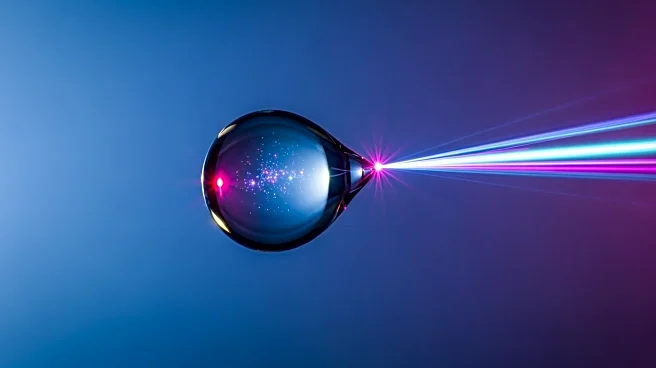
Researchers have successfully captured images of individual oxygen atoms dissolved in water using a femtosecond two-photon absorption laser-induced fluorescence (fs-TALIF) technique. This breakthrough, published in Nature Communications, challenges previous
assumptions about the behavior of oxygen atoms in liquid environments. The study revealed that these atoms remain stable for tens of microseconds and can travel several hundred micrometers into the liquid, a finding that defies existing scientific models. The research team used an ultrafast femtosecond laser to excite the oxygen atoms, allowing them to fluoresce before being quenched by surrounding water molecules. This method enabled the detection of a dissolved oxygen density near the water surface, providing new insights into the movement and stability of atomic oxygen in aqueous environments.
Why It's Important?
The ability to image and measure atomic oxygen in water has significant implications for various fields, including medicine, industrial chemistry, and fundamental research. Atomic oxygen is known for its powerful oxidative properties, which can be harnessed for innovative applications. Understanding how these atoms behave in liquid environments is crucial for developing new technologies and processes that rely on their reactivity. This research could lead to advancements in pollution cleanup, water treatment, and the development of new chemical processes. Additionally, the findings may prompt a reevaluation of existing models of atomic behavior in liquids, potentially leading to new scientific discoveries and applications.
What's Next?
Future research will likely focus on further exploring the behavior of atomic oxygen in different liquid environments and under varying conditions. Scientists may also investigate the potential applications of this technique in other areas, such as environmental monitoring and chemical synthesis. The development of more advanced laser technologies could enhance the precision and applicability of this method, opening new avenues for research and innovation. Additionally, the scientific community may work on updating theoretical models to incorporate these new findings, which could lead to a deeper understanding of atomic interactions in liquids.