








What's Happening?
Skye Jethani, in 'Letter Four: Joy' from his new book 'The World Born in You,' addresses his young adult children about navigating a divided, post-Christian America. He contrasts the current culture, which he describes as designed to promote and reward
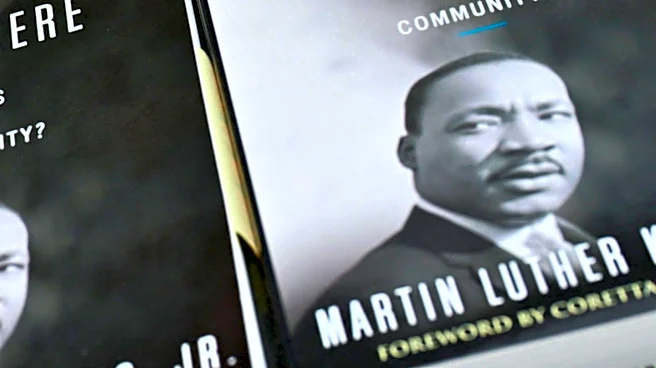
outrage, with historical figures like Martin Luther King Jr. Jethani notes that King, despite the justifiable anger of Black Americans during the Civil Rights Movement, warned against harboring anger and advocated for channeling its energy 'constructively' and 'peacefully' to address societal oppression. Jethani argues that today, Christians are as prone to celebrating anger as the wider culture, often equating contempt with concern in an attention economy where the loudest voices gain notice. He suggests that a lack of expressed anger is now often misinterpreted as apathy, leading to criticism for not being sufficiently outraged.
Why It's Important?
Skye Jethani's analysis in 'Letter Four: Joy' is highly relevant to the current social and political climate in the U.S., where polarization and public discourse are often characterized by anger and outrage. By drawing a parallel to Martin Luther King Jr.'s nuanced approach to anger during the Civil Rights Movement, Jethani highlights a critical distinction between justified indignation and destructive rage. This perspective is crucial for fostering more constructive dialogue and activism in a society where social media algorithms often amplify extreme viewpoints. The piece challenges both secular and religious communities to re-evaluate their engagement with anger, suggesting that equating 'contempt with concern' can be detrimental to genuine progress and spiritual well-being. This discussion is vital for promoting healthier forms of civic engagement and personal reflection in a deeply divided nation.
What's Next?
Skye Jethani's 'Letter Four: Joy' is part of his new book, 'The World Born in You,' which offers guidance to young adults on navigating contemporary American society from a faith perspective. Readers can continue to engage with Jethani's insights by reading the full book and other letters in the series. The themes discussed, particularly the role of anger and joy in public discourse, are likely to continue to be relevant and debated within religious and secular circles. Jethani's work encourages ongoing reflection on how individuals, especially those of faith, can contribute to a more constructive and less outrage-driven societal conversation, potentially influencing personal approaches to activism and social engagement.
Beyond the Headlines
Jethani's observation that the 'culture of algorithms and activism' promotes outrage has profound implications for the future of American democracy and social cohesion. The digital landscape, with its emphasis on engagement metrics, often inadvertently incentivizes inflammatory content, leading to echo chambers and heightened polarization. This phenomenon not only affects political discourse but also permeates religious communities, as Jethani notes, where the pressure to demonstrate 'sufficient outrage' can overshadow more nuanced or compassionate responses. The piece implicitly calls for a re-evaluation of digital citizenship and media consumption, urging individuals to resist the algorithmic pull towards anger and instead cultivate a more discerning and constructive approach to social issues. This deeper implication touches on the very fabric of how information is consumed and how public opinion is shaped in the digital age, suggesting a need for greater media literacy and ethical engagement with online platforms.