
What's Happening?
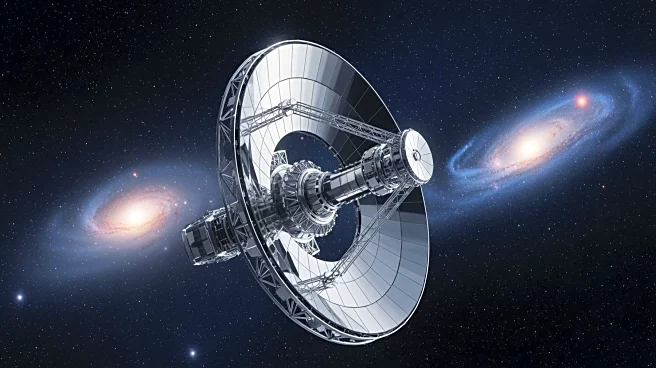
NASA has successfully completed the assembly of the Nancy Grace Roman Telescope, marking a significant milestone in its development. The telescope, which is set to launch as early as Fall 2026, is designed
to explore dark energy, conduct an exoplanet census, and image nearby exoplanets. The Roman Telescope features two main instruments: the Wide-Field Instrument (WFI) and the Coronagraph Instrument (CGI). The WFI offers a view 100 times larger than the Hubble's, while the CGI will help in observing exoplanets by blocking out starlight. The telescope is expected to generate 20,000 terabytes of data during its five-year mission, potentially extending beyond that if fuel permits. The Roman Telescope aims to provide insights into the universe's expansion and the nature of dark energy.
Why It's Important?
The completion of the Nancy Grace Roman Telescope is a pivotal development for the scientific community, as it promises to enhance our understanding of the universe significantly. By studying dark energy and conducting a comprehensive exoplanet census, the telescope could provide answers to fundamental questions about the cosmos, such as the nature of the universe's expansion and the potential for habitable planets beyond our solar system. The data collected will be invaluable for researchers and could lead to groundbreaking discoveries that reshape our understanding of space and time. The telescope's ability to image vast swathes of the sky quickly will accelerate the pace of astronomical research, offering new opportunities for scientific exploration.
What's Next?
The Nancy Grace Roman Telescope will undergo extensive testing before being transported to the Kennedy Space Center in Florida for its scheduled launch in May 2027. However, if preparations proceed smoothly, the telescope could be ready for launch by Fall 2026. Once operational, it will orbit the Sun-Earth L2 point, where it will begin its mission to explore the universe. The scientific community eagerly anticipates the data and discoveries that the Roman Telescope will provide, which could have profound implications for our understanding of the cosmos.